
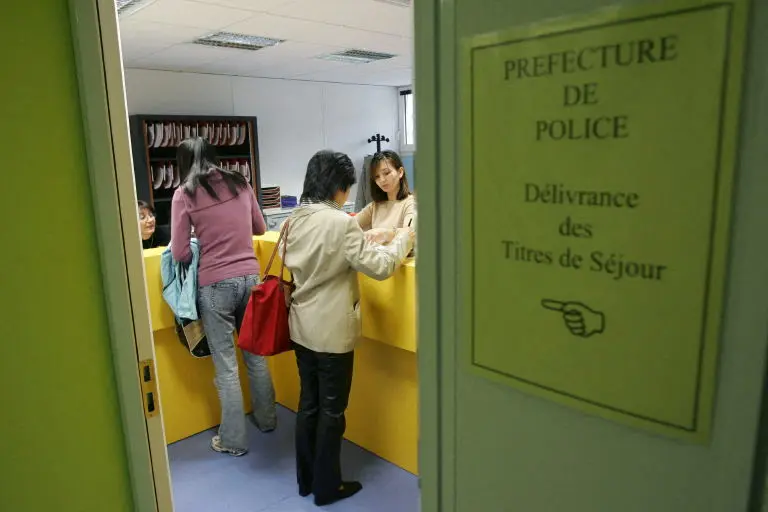
In January 2024 French politicians passed a new immigration law that included changes to language requirements in France's new immigration law. Once the law was passed, we asked readers of The Local to send us their questions on the new rules.
Here's what they asked;
What exactly are the changes?
France's new immigration law will increase language requirements in three areas;
Those making their first application for a carte de séjour pluriannuelle (multi-year card, max duration of four years) will now need to demonstrate a French level of at least A2 according to the DELF/ CERL international language scale.
Those making their first application for a 10-year carte de résident (in most cases, available after five years of consecutive residency) will need to demonstrate at least B1 level in French - an increase from the previous requirement of A2.
Those applying for French citizenship will need to demonstrate at least B2 level in French, instead of the previous requirement of B1.
You can take our language quiz HERE to get an idea of where you sit on the DELF scale
Are one-year cards affected?
No, the changes only apply to the multi-year residency cards listed above. Most people moving to France for the first time will first be given a short-term one-year visa, which they can usually convert into a one-year carte de séjour.
The pluriannuelle card and the carte de résident are, in most cases, only available after multiple years of consecutive residency in France.
What about visas?
No, there are no language requirements to get a French visa, and this will not change.
When will the changes take effect?
The new language requirements go into effect starting on January 1, 2026, and they will concern only new applications (i.e. those submitted on or after January 1st).
Which groups can apply for a pluriannuelle card?
People applying for this card for the first time will need to show at least an A2 in French from January 2026.
This card is not available to everyone - only those coming to the end of their previous short-term card can apply. There are pluriannuelle categories for those with the vie privée et familiale (family and personal life status), the salarié (worker status), and the étudiant (student status). More information here.
People with the following short-term residency cards cannot apply for the pluriannuelle card;
- Carte de séjour temporaire visiteur (visitors, including retirees holding the 'visitor card')
- Carte de séjour temporaire "travailleur temporaire" (temporary worker)
- Carte de séjour temporaire vie privée et familiale délivrée aux victimes de la traite des êtres humains ou du proxénétisme, ou bénéficiaires d'une ordonnance de protection (victims of human trafficking or those under a protection order)
- Carte de séjour temporaire jeune au pair (au pairs)
- Carte de séjour temporaire stagiaire (interns)
Which groups can apply for the carte de résident?
People applying for this card for the first time will need to show at least a B1 in French from January 2026.
The most common version of this card - the carte de résident de longue durée-UE (étranger en France depuis 5 ans) - is available for those who have lived in France consecutively for five years.
People who have held visitor status - including foreign retirees - can apply for this card. Similarly, those with the family and private life status (vie privée et familiale), workers (salariés), self-employed people/ freelancers (entrepreneur/ profession libérale), and talent card holders can also apply for this card after five years.
You can find the other requirements on the Service-Public site.
Some groups can apply for the 10-year carte de résident after three years' residence in France - you can find the full list here, which includes spouses of French nationals, spouses or children of foreign nationals who came to France via family reunification, and parents of minor French children.
Will people over the age of 65 be forced to take language tests?
In brief, it depends on what you are applying for.
The French government recently clarified to The Local that people aged 65 and over will not be required to demonstrate a minimum language level or pass a civics test when applying for certain types of residency cards.
While the initial version of the law did not mention an exemption for older people, a new decree published on July 15th includes an exemption for people aged 65 and over for both the French language test and the civics test, if they are applying for long-term residency cards.
There is also an exemption for certain groups (people on visitor cards, for instance) to the rules limiting the number of card renewals, so there is the option to simply stay on the yearly renewals, which have no language requirements (more on the renewals rule below).
When it comes to citizenship, an age-based exemption to language rules was scrapped back in 2020 so currently almost everyone has to provide proof of their language level. This will also apply to the higher language level under the new law.
The only two possible exemptions;
- People who meet all three of the following criteria; refugees, aged over 70 and have lived in France for 15 years or more
- People with disabilities and/or cognitive impairment that means they cannot take an exam. This certification from a doctor (more on this below).
READ MORE: Are pensioners exempt from France's new language test rules?
Do the new citizenship rules apply to everyone? What about people applying by marriage?
There are two ways of obtaining French nationality: through residency (par décret) or through marriage or family ties with a French person (par déclaration).
The déclaration process concerns those who are applying via marriage or family. Meanwhile, décret (sometimes called par décret de naturalisation) is a different procedure subject to several conditions, including length of residence in France.
Stricter language requirements for citizenship (the B2 level) will apply to both applications by residency and marriage/ family ties.
Meanwhile, for the residency cards (both pluriannuelle and carte de résident), there are no differences based on marriage status - meaning those married to French nationals would still need to show an A2 and B1 level (respectively).
What about the limit on card renewals? Will I be forced to take a language test eventually?
As we've said, the language requirements apply only to people applying to move from one-year cards to multi-year cards. Most people opt to do this as soon as possible to avoid both the yearly hassle of renewing and the €225 fee for each renewal.
But is there an option to avoid the language requirement by simply staying on the yearly card indefinitely?
Again - it depends on your status.
The new law includes a clause - Article 21 - which states "there cannot be more than three consecutive renewals of a temporary residence card bearing an identical mention (title)."
This will effectively force some groups of people to either switch onto a pluriannuelle card or a carte de résident.
However, there are several groups exempted from this rule:
- People with the following short-term (carte de séjour temporaire) cards are exempt: visitors, temporary workers, students, interns, and some categories of 'family and private life' (incl. young foreigners born in France and seriously ill people).
- Posted workers (those with multi-year salarié détaché status and their families) and seasonal workers with multi-year cards (travailleurs saisonniers) are exempt
- Several categories for the talent passport (including passeport talent, passeport talent-carte bleu européene, passeport talent (famille), passeport talent-chercheur-programme de mobilité) are also exempt
As such, many readers will not be impacted by this change, including early retirees who are likely to have the 'visitor' cards.
The main groups who will have to consider the limit on temporary card renewals will be those with self-employed/ freelancer (auto-entrepreneur) and employee (salarié) status, as well as some people on family and private life cards.
What about people with a 'passeport talent'?
There are several categories of 'talent passport' - now simply referred to as the 'talent' card (to avoid confusion with the word 'passport'). The new immigration law also created a new one for foreign healthcare workers to come and work in France more easily.
In many cases, people coming on a talent passport visa (and their family members) are issued with a four-year carte de séjour straight away, with no requirement to take a language test. This will not change.
When the time comes to renew the card, you can renew it for another four-year 'talent' carte de séjour, provided you still meet the conditions (eg salary, type of work). No language test is required for the renewal.
As mentioned above, the talent categories are exempt from limits on renewals. They are also exempt from other new rules created for a first-time request of a pluriannuelle card, including the need to show at least an A2 language level and the integration/language courses offered by OFII.
If, however, you decide to apply for either the 10-year carte de résident or for French citizenship, you will be covered by the new language requirements.
READ MORE: How is France's 'talent passport' affected by new language rules?
What if I am renewing my card?
If you already have a pluriannuelle card or 10-year carte de résident and need to renew it, you should not be affected by the changes.
According to a press release from France's interior ministry, the change will be for "the first issue of a carte de séjour pluriannuelle" and the "first issue of a carte de résident".
What about people with post-Brexit cards?
Brits who are covered by the Withdrawal Agreement (ie those who lived here before January 2021) have a special post-Brexit carte de séjour - known as a WARP (Withdrawal Agreement Residency Permit) or in French, an Article 50 TUE.
This card was for people who were living in France prior to December 31st 2020. Brits who moved to France after that date, in most cases, do not have the Brexit card.
Anyone with a Brexit card is not affected by the changes to residency cards, since they do not need either the pluriannuelle or the carte de résident.
READ MORE: How are Brits in France affected by new language test requirements?
Brits who had lived here for more than five years by 2020 were given a carte de séjour permanent straight away. Those who had lived here for less than five years were given a five-year card. When this comes up for renewal (in 2026 in most cases) it can be exchanged for the carte de séjour permanent without the need to take a French test.
What if I already took the B1 test and I had planned on applying for citizenship soon?
The new rules are expected to take effect from January 2026. Until then, the old rules will still be applied to those who have already submitted their applications.
How much harder is B2 than B1?
The CEFR language levels are A1 and A2 for beginners, B1 and B2 for intermediate, and C1 and C2 for fluent speakers.
However, many are concerned that there is a large leap between the levels of B1 and B2. According to CEFR estimates, you’ll need to study for 350-400 hours to reach B1 from scratch, so a couple of hours a week is two years or so.
If you’re already at the A1/A2 level, cut that down to an additional 150-200 hours of study. The more time you can commit, the shorter the timescale.
READ MORE: How long does it take for your French to reach A2, B1 or B2 level?
How do I prove my language level?
For citizenship - the current accepted proof is;
- A diploma proving you passed the Brevet
- A diploma proving you received higher education instruction in the French language. The types of courses permitted can be found here
- A diploma attesting you have at least a B1 level on the CERL (eg. a DELF exam)
- Proof of higher education in a francophone country (you will need to get a 'comparability' - found here)
- An attestation de réussite (under two years old) showing you passed the TCF (test de connaissance du français), delivered by France Éducation International
- An attestation de réussite (under two years old) proving you passed the TEF (test d'evaluation du français) delivered by the Chamber of Commerce and Industry of Paris Île-de-France
Keep in mind that the TEF IRN only goes up to the B1 level, so it will not be acceptable proof for B2.
Otherwise, even though the level is changing from B1 to B2, a DELF exam, proof of higher education at a French institution or in a francophone country, as well as the TCF are likely to continue to be accepted as proof.
For the carte de résident previously accepted proof was;
A language certificate issued by a body recognised by the Interior Ministry. This included a test score from the TCF (issued from France Éducation International) and the TEF (issued by the Paris Chamber of Commerce and Industry) or proof of higher education in France or a francophone country.
It is likely that this will remain the same, but at the higher level of B1.
For the pluriannuelle card, it is expected that TCF and TEF scores will be accepted.
What happens if I fail the test?
While this is inevitably disappointing, you would simply have to book (and pay for) another test and try again. This will not reflect poorly on your application for a new residency card or citizenship, but it will likely slow down your timeline and take more money out of your pocket.
What if I have a disability, eg, dyslexia?
If you are disabled or chronically ill, you may be able to take a language test with special arrangements. You can find a breakdown of accommodations available for the DELF/DALF exams here (PDF).
If you are unable to take such a test, you may also be exempted from the requirement altogether.
Your GP can complete a medical certificate, which will be turned into your local préfecture alongside your application.
For citizenship, you can download the form for your doctor to fill out on the Service-Public website (under Certificat Médicale).
How can I find a test-taking centre?
There are several options, as long as the test covers the CERL levels.
You can find an interactive map with recognised test centres at the France Éducation International website.
READ MORE: How much do French language tests cost and where can I take them?
How much do the tests cost?
Taking the test can unfortunately be expensive - between €100 and €200 is standard, although there are regional variations.
You may also consider paying for a couple of language classes in advance if you are unsure, or just to let you take a few practice papers and get some feedback.
Those working in France might consider using 'Mon Compte Formation' to pay for classes.
All employees in France get an annual 'training budget' of up to €800 that you can spend on developing your professional skills - and if you're foreign, you can use that budget for language classes, many of which conclude with a DELF placement test at the end.
If you have further questions, feel free to email us at news@thelocal.fr
 Emma Pearson

Comments (2)