
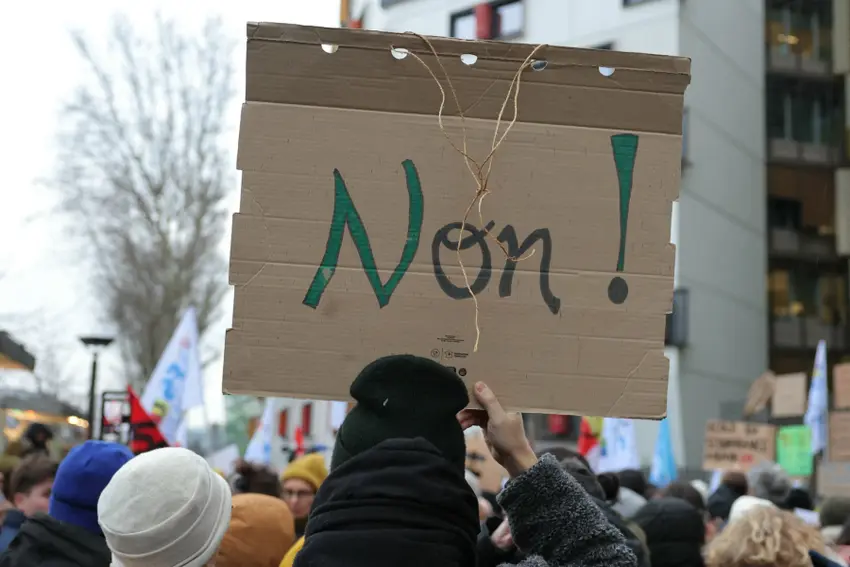
While French strikes and protests are rarely dangerous for tourists, they can be inconvenient, and they do happen several times a year.
Oftentimes, French strikes are targeted at the public sector - so they are highly likely to impact your life.
If you do find yourself caught up in one, here are the French words and phrases you will need.
Une grève/en grève/les grevistes - Let's start with the basics, a strike is une grève and a worker who is taking strike action is en grève - on strike. The collective term for striking workers is les grévistes.
Un movement social - This is another phrase for any type of industrial action or social movement that you will frequently see on announcement boards to explain the reason for a closure or delay.
Les syndicats - The unions. France has a number of different unions even within the same professions, so for example, railway workers can be represented by several different unions. In general there is only very severe disruption if the unions coordinate their strike action.
Intersyndicale - While intersyndicale can refer to any gathering of different unions representing the same sector or geographical area, if the French press is discussing an upcoming meeting of the l'intersyndicale, they are likely referring to the national one.
Since 2008, the eight main French union federations - the CGT, CFDT, FO, CFTC, CFE-CGC, UNSA-Solidaires, and FSU - have formed the intersyndicale interprofessionnelle (inter-union gathering across sectors). Occasionally, this intersyndicale is joined by unions representing students as well.
If the intersyndicale calls for strikes, then you can usually expect severe disruption across sectors.
Perturbé - Disrupted. One reason France seems to have so many more strikes than anywhere else is that the strikes that do take place tend to target public services, particularly transport so are highly visible and very disruptive. You will frequently see and hear announcements on public transport networks that services are perturbé en raison d'un mouvement social - disrupted because of strike action.
Annulé - Cancelled
Supprimé - Usually translated as deleted or removed, if you see this on a notice board, it means that your train or plane has been cancelled.
Retardé - Delayed. If you train/bus/plane is delayed, you will see retardé on the notice board, or more specifically xx minutes à tard or xx minutes retardé - xx minutes late.
Compensation - If you have been delayed by strike action you can claim compensation, and helpfully the word is the same as in English. You might also see remboursement (reimbursement) and échange (exchange).
READ MORE: Travel to France: Your rights for delays or cancellations during a strike
Une trêve - a truce. If a strike falls over a major public holiday such as Christmas, it's possible that strikers can declare a 'truce' then resume industrial action after the holiday.
You may see newspapers talking about the possibility of une trêve de Nöel - a Christmas truce, where for example rail workers would break off their strike in order that French people can travel to be with their families at Christmas.
Opération escargot - It might translate as 'snail operation', but it is actually defined as "an action consisting of provoking a significant slowdown in traffic, or even a blockade, for protest purposes".
It's what in English we would probably refer to as a rolling roadblock, the practice of disgruntled drivers - often hauliers or farmers - driving very slowly along a road, causing huge tailbacks behind them.
Blocage - a 'blockade'. This might be used to describe protesters attempting to block a motorway, but it is often used to reference blockades outside of factories, fuel depots, and occasionally supermarket distribution centres.
READ MORE: Nine French words to help you complain about chaos
La pagaille - Chaos or a shambles. You may find that in contrast to foreigners, the French are fairly phlegmatic about strikes. Yes they happen, and yes, they are annoying but you're unlikely to see many French people going totally berserk about them.
This could be because they are aware of the link between strong unions and the protections and social support that employees in France enjoy. Nevertheless, grumbling is always fun and if you want to describe a situation as a total shambles, this is a good word.
For example La grève a semé la pagaille à la gare Montparnasse - The strike has caused chaos at Montparnasse station.
READ ALSO How to stop worrying and learn to love French strikes
C'est relou - It's really annoying. A slightly slangy verlan expression, this is a good one for describing something as really annoying or 'that sucks'. Tous les vols sont annulés, c'est relou - All the flights are cancelled, it sucks.
Putain - and of course if you're enormously inconvenienced by a strike (for example you have just learned that all the trains available to get you home in time for your own wedding have been cancelled) you could use the best (and rudest) French word of them all. If you're getting all sweary, you could also refer to the situation as bordel - fucked up - or bordel de merde - totally fucked up.
Once you've finished swearing about it, it might be time to get into an interesting political discussion about the issues raised by the strike action.
Bras de fer - to strong-arm somebody or to stand firm during a conflict. At strike time, newspapers will frequently use this to refer to the positions of the strikers or the government, eg Bras de fer sur la réforme des retraites - [The government is] standing firm on the pension reform.
Faire machine arrière - more or less the opposite of bras de fer, is faire machine arrière, which means to make a machine go backwards or to backpedal. If you hear that le gouvernement avait fait machine arrière (the government has backpedalled), then the strike will probably end soon. You might also hear rétropédalage, which also means backpedalling or backing down.
Le Gréviculture - Slightly controversial addition, this. You might hear people using it but we wouldn't advise using it yourself as it can be a sensitive subject in France. The word means 'strike culture' and people sometimes use it to grumble about a lot of strikes, but the phrase has some baggage.
Comments