
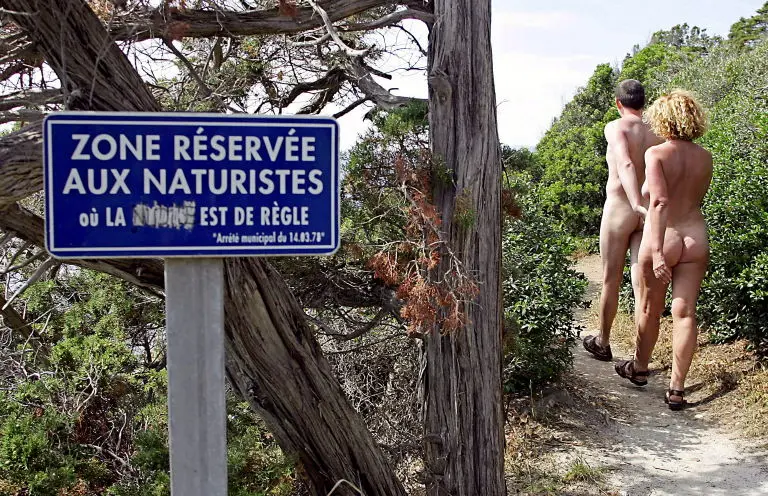
According to a 2025 Ipsos survey conducted for the French Naturist Federation, the number of people practising naturism in France has risen from 2.5 million a decade ago to an estimated 3.7 million today.
The federation also estimates that around two million tourists travel to France each year specifically for naturist holidays.
Listen to the team at The Local discussing naturism on the latest Talking France podcast - download here
The survey questioned 1,000 French people aged between 18 and 75. Among those surveyed, 21 percent said they had practiced naturism on a beach at least once, 19 percent had done so in a natural setting, and 12 percent had visited a naturist holiday centre.
Young adults under the age of 34, 32 percent of 18-24 year olds and 37 percent of 25-34 years old say they’re open to the idea.
The survey also suggests that public attitudes towards naturism is becoming more positive. Around 31 percent of respondents described it as a positive practice, while 70 percent agreed with the federation's definition of naturism as a philosophy of life. Some 61 percent said it encourages body acceptance and 42 percent believed it helps people reconnect with nature.
However, not everyone seems to be on the same page. More than a third of respondents described naturism as "a bit ridiculous", half expressed concerns that it could "go too far", and nearly one-third considered it outdated.
READ ALSO: Naturism: Why France is the best country to get naked in
The International Naturist Federation defines naturism as "a way of life in harmony with nature, characterised by the communal practice of nudity, which aims to foster self-respect, respect for others and respect for the environment".
It's a lifestyle intended to encourage a closer relationship to nature and other people.
A long history
In the 18th century, naturism emerged primarily as a medical philosophy inspired by Hippocratic ideas that viewed nature as a source of healing. Early practitioners promoted natural remedies and believed that illness represented the body's attempt to restore balance.
At that stage, naturism had little connection to nudity. However, during the 19th century, growing interest in alternative therapies encouraged practices such as exercise, cold-water therapy, sweating and herbal medicine.
Influenced by similar movements in Germany, advocates increasingly promoted the health benefits of fresh air, sunlight and outdoor living. Over time, this evolved into a closer physical connection with nature, including the taking off of all clothing.
The movement expanded significantly in the early 20th century. In France, doctors André and Gaston Durville established Physiopolis on the Île de Platais in the Yvelines département west of Paris in the late 1920s. Considered France's first naturist resort, it attracted thousands of visitors before the Second World War.
The rules of naturist places
Although France has a thriving naturist community, that does not mean you can get naked anywhere and in fact there are quite strict rules about being naked in public.
Therefore naturism is usually practised in designated spaces - on naturist beaches or in the many naturist holiday centres, campsites or even whole towns or islands. Naturist beaches are usually clearly signed.
Naturist spaces operate according to a set of rules. Many campsites and beaches are designated as mixte, meaning both clothed and unclothed visitors are welcome. Other locations require complete nudity and don't allow clothing at all.
Privacy is also a key concern. Photography is prohibited in communal areas of naturist campsites to protect everyone's privacy.
Beyond formal regulations, there are also unwritten rules of behaviour - discretion, respect and consideration for others are regarded as essential while staring, intrusive behaviour or unwanted advances are considered unacceptable.
Naturist organisations stress that nudity itself is viewed as neutral and non-sexual, with an emphasis on creating a comfortable environment for everyone.
France's naturist locations
France has 116 designated naturist beaches, according to naturist organisations, with 28 located along the Mediterranean coast.
Popular destinations can be found in the Bouches-du-Rhône département, including beaches near Marseille and Cassis, while other well-known sites are located in the Alpes-Maritimes around Cannes and in the Var département near Hyères and Ramatuelle.
The naturist island
Among France's most distinctive naturist destinations is the Île du Levant, located off the southern coast of Hyères. The island is home to around 180 year-round residents and approximately 220 properties, including hotels and campsites. Much of the island operates according to naturist principles.
On most beaches, nudity is mandatory, with the exception of a small mixed beach near the harbour. Elsewhere, visitors often wear only minimal clothing while walking through the village or along paths.
Anne, who has spent nearly every summer on the Île du Levant for the past 50 years, told The Local that naturism on the island is about more than simply being naked.
For her, the island represents a form of naturism that differs significantly from the atmosphere at some other well-known destinations, such as Cap d'Agde.
"In Cap d'Agde you're naked everywhere. It's just being naked for the sake of it," she said. "On the island, and in many naturist places in Germany as well, you're naked to be close to nature. The idea is to stay minimalist and environmentally aware. It's a completely different dimension."
Like many long-time residents and visitors, Anne says the island has faced challenges in recent years, particularly from voyeurs and people who visit out of curiosity rather than an interest in naturism itself.
The island also experienced tensions with authorities in 2018, when naturist associations launched a petition accusing municipal police of excessive enforcement against nudists.
According to Anne, relations have improved since then and daily life has largely returned to normal.
"The tensions have calmed down," she said, noting that a local shopkeeper has resumed working naked without attracting unwanted attention.
Naturism v Nudism - nudism is described as "being naked to be seen", usually for either sexual or political reasons. Therefore people who get naked as a way of getting close to nature or living in a more natural way usually prefer the term naturism.
Comments