
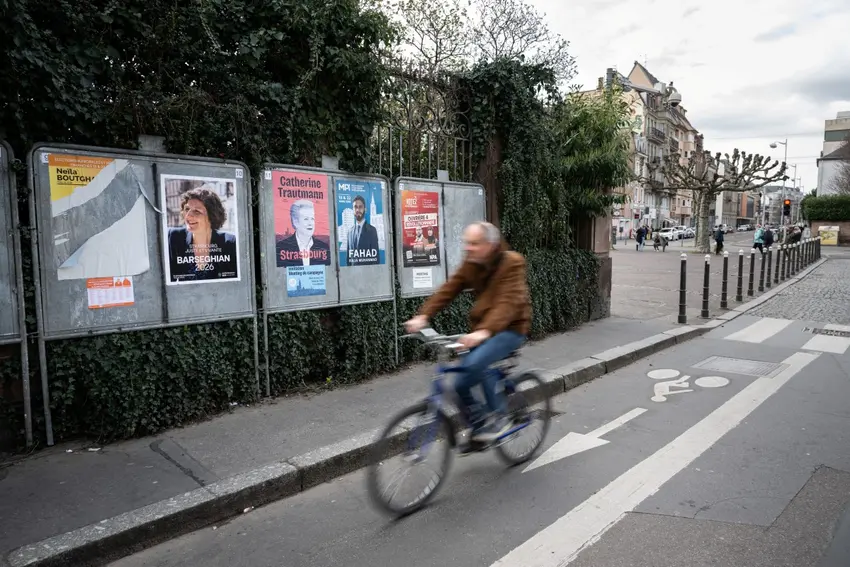
France will hold 35,000 elections on Sunday, March 15th – an explosion of very local democracy while many eyes in France and the rest of the world are turned elsewhere.
French municipal elections are always important. Even the smallest village mayors in France have some power. Big city mayors have real power.
This month’s election is even more important than usual. It will be the last big democratic test before a Presidential election next spring which could stand French and European politics on its head.
READ ALSO: 8 things to watch in France’s upcoming local elections✎
The Far Right Rassemblement National enjoys an insolent, 19-point lead over all-comers in national polls before the presidential election in April and May 2027.
National and local politics in France beat to different drums. The RN’s unprecedented strength will not produce a tidal wave of local victories this Sunday and next.
Nonetheless, the results in a handful of large towns and cities could build, or check, the momentum of the Far Right as France stumbles towards its most dangerous post-war election.
Listen to John and the team at The Local discuss the elections in the latest episode of the Talking France podcast - download here or listen on the link below
The RN and its allies have a serious chance of winning two of France’s largest cities, Marseille and Nice, for the first time. They hope to reclaim Toulon, which had a disastrous experiment with Far Right politics in the 1990s. Overall, they hope to triple their 2020 haul of a dozen town halls, large and small.
The municipal elections will tell us how much life remains in the so-called “Republican Front” – the willingness of voters of left, moderate right and centre to combine to block the Far Right in the second round of an election.
The results in a few big cities – Paris, Marseille, Toulouse - will show whether the Centre-left has any real hope of regaining the ground lost to Emmanuel Macron’s Centre and Jean-Luc Mélenchon’s Hard Left since 2017.
Ditto for the Centre-right in Paris, Lyon and Nice.
Even before a single vote is cast, the mayoral elections have illuminated one of President Emmanuel Macron’s greatest mistakes – his failure to build a grass-roots centrist movement during his nine years in the Elysée Palace.
Macron’s party, Renaissance, has a mayoral candidate in just 24 towns with populations of 30,000 or more, five times fewer than six years ago. Elsewhere - as in Paris, Marseille and Nice - Renaissance is running a junior partner to other parties of the centre, centre-right or centre-left.
Many village races will be decided in the first round this weekend. The bigger races are complex. They will depend on which lists of candidates qualify for Round Two; whether some lists merge or withdraw; and, no matter what the local party leaders decide, how voters actually switch between candidates on Sunday week.
The rules vary according to the size of the commune (nothing in French electoral politics is simple). In the larger communes, lists of candidates which attract more than 10 percent of the vote can run again in Round Two. Over 5 percent, they can merge with bigger lists.
READ ALSO: EXPLAINED: The crucial 'alliances' that shape French elections✎
The second round is sometimes fought by two lists but often by three or four. The list which comes first past the post in the second-round, even by a handful of votes, scoops a “win bonus” of half the council seats. The leader of the list becomes mayor. The rest of the seats are divided proportionally between all the lists, including the winner.
The rules explain the complex dynamics in a handful of key cities.
Thus…
In Marseille, the Centre-left mayor Benoît Payan (31 percent) is neck-and-neck in the opinion polls with the far-right candidate Franck Allisio (29 percent). All will depend on whether the centre-right Les Républicains and Hard-left La France Insoumise qualify for Round Two. If they don’t run again, how will their supporters split between the leading candidates?
Mayor Payan’s survival depends partly on the centre-right running again and on the Mélenchonist LFI standing aside. He doesn’t want to “merge” with the LFI because that would offend some of his potential centrist voters. A real Rubik’s cube of a race.
In Nice, the incumbent mayor, Christian Estrosi is running for Emmanuel Macron’s three-party centrist alliance and the Centre-right, Les Républicains. According to polls, he trails ten points (41 percent to 31 percent) behind his friend turned bitter enemy, the local MP Eric Ciotti, who leads a breakaway right-wing party allied with the RN.
The election will be decided by whether the left-wing parties qualify or stand down in Round Two and the readiness of their voters to transfer tactically to Estrosi to keep out Ciotti and the Far Right.
In Paris, the Socialist deputy mayor, Emmanuel Grégoire, has a solid 31 percent to 24 percent first-round opinion poll lead over the ex-culture minister Rachida Dati, who is running for the centre-right and part of Macron’s centrist coalition.
Pierre-Yves Bournazel , running for two of the three centrist parties, trails with 14 percent. The far-left candidate, Sophia Chikirou, has 12 percent. The RN is nowhere. The Far Right vote has moved mostly to Sarah Knafo (12 percent), the candidate of Eric Zemmour’s otherwise struggling, alternative Far Right party, Reconquête.
All depends on which of Bournazel, Chikirou and Knafo qualify and, if not, how their voters will shift on Sunday week. The hard left LFI appears determined to trip up the Socialists; the Centrist Bournazel appears determined to tun again and sink Dati. Their voters may have other plans.
One other result will be worth watching out for on Sunday night – with direct implications for the presidential election next year. In Le Havre, the incumbent mayor is Edouard Philippe, Emmanuel Macron’s first Prime Minister (2017 to 2020) and the strongest of a weak pack challenging the RN next year.
READ ALSO: ANALYSIS: Who's who in France's 2027 presidential election race✎
Philippe is neck and neck in the local, first-round opinion polls with Jean-Paul Lecoq, a local Communist trades union leader. Tactical switching in Round Two threatens to unseat him.
If Philippe loses, he says that he will abandon his presidential campaign - tipping next year’s race even more towards the Far Right.
Comments