
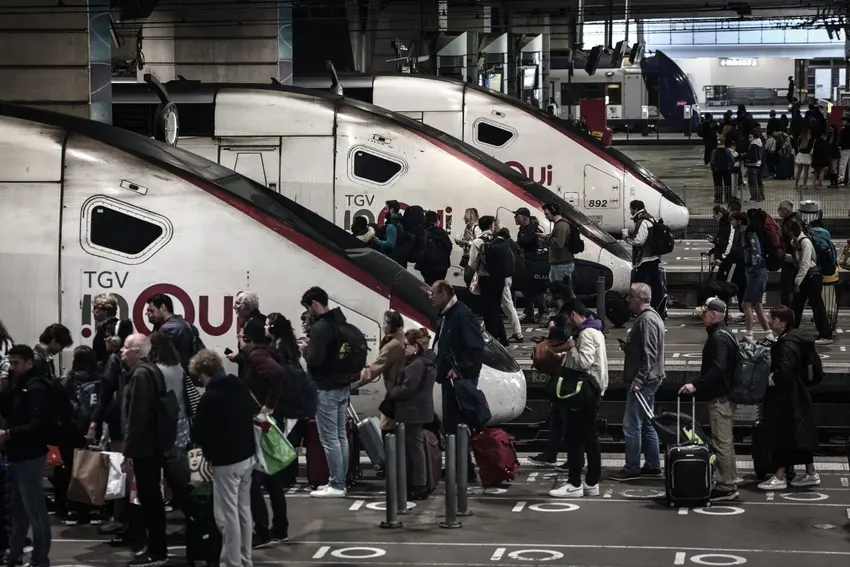
If you were to pay even the slightest attention to the news in France you’d probably reach the fairly rapid conclusion that SNCF and strikes go together like love and marriage. Or, for the more cynical out there, a horse and carriage.
Earlier this month, French union Sud-Rail announced it had filed a summer-long strike notice beginning on Thursday, June 12th, at 7pm, which will last until Monday, September 1st, at 8am, allowing them to walk out with minimal notice at any time over that period.
This latest threat followed strikes in May and December.
And it's not like the last 12 months are an anomaly - France has in fact seen at least one rail strike every year since 1947 (and probably longer, but records only go back that far).
You might imagine, then, given all the inevitable disruption caused by repeated walkouts, that rail operator SNCF would find it difficult to attract customers to use its services.
But you would be wrong.
In February, SNCF confirmed it had carried nearly 130 million passengers in 2024, breaking a record of 122 million set the previous year.
In fact, passenger numbers in 2024 were up four percent year on year, and were 11 percent higher than 2019 – a pre-pandemic year used as a reference for this decade to judge the current success of rail services.
The group also reported a net profit of €1.6 billion last year – the fourth consecutive year it has ended up with a positive balance sheet. In 2022, it recorded record annual profits of €2.2billion.
“We are truly in the golden age of the train. We are building a virtuous circle for rail travel,” said SNCF Voyageurs’ CEO Christophe Fanichet told journalists. “This is a sustainable trend,” he said.
Full trains
One in three TGV trains runs full - according to Fanichet - while the low-cost Ouigo TGV services were full 60 percent of the time.
French trains must be booked in advance, and on the high-speed TGV and Intercité services a booking automatically generates a seat reservation. The plus side of this is that you can be sure of a seat and won't be forced to spend the journey standing in the corridor outside the toilets, the down-side is that when trains are full they stop ticket sales - meaning that last-minute travel is often not possible.
On the local TER services and suburban routes such as the greater Paris Transilien seat reservations are not taken, meaning that you might end up standing (but you can make a last-minute journey).
Overall SNCF reported that – with 364 trains available – it struggled to meet demand for TGV services in 2024.
READ ALSO MAP: Where high-speed trains can take you in France
It has ordered 115 new generation TGV M trains to augment its current fleet, but the first of those will not enter service until 2026. Integrating more Ouigo services, however, partly offset the problem, SNCF has said.
“Last year, for the summer, we added half a million seats, and we will continue to increase performance – that is, make trains run more,” Fanichet said.
Last year, 38 Ouigo trains were operational - this number will rise to 50 by 2027. Ouigo trains run on the same routes as the TGV Inoui trains but are cheaper and offer a slightly more basic experience (no buffet car or onboard wifi, limitations on luggage).
High speed versus low speed
And it’s not just the high-speed TGV services that are holding up the numbers.
Local TER services across the country saw a 10 percent increase in passengers in 2024, Transilien travellers in the Ile-de-France region rose eight percent, and seven percent more people took an Intercité service last year than in 2023.
Night trains are part of the Intercité network, and these broke the one-million passenger barrier for the first time in 2024, as SNCF adds more routes and works on adding extra international links.
France's local train TER network, which makes up around nine tenths of the total rail lines, is often described as the 'cinderella' service compared to the TGVs - underfunded, scarce, creaky, less reliable and more likely to see trains cancelled during a strike.
However despite their problems TER services have seen a rapid increase in passenger numbers. In 2023, TER services welcomed 21 percent more passengers than in 2022, while it was reported that travellers on local rail services in Occitanie alone had jumped 40 percent in four years.
That's not to say that everything is perfect, there are still numerous rail issues in France.
Regional president for Occitanie Carole Delga this week revealed plans to keep trains running on threatened lines in the region, for example, while one département is eagerly awaiting its first passenger service in more than 50 years.
READ ALSO Could France’s ‘forgotten département’ see the return of train services?
But, if the numbers are anything to go by – can nearly 130 million people be wrong? – there’s little sign of that the current popularity of rail travel is going to fade away soon.
And the threat of strikes certainly don't seem to be putting off passengers.
Comments