
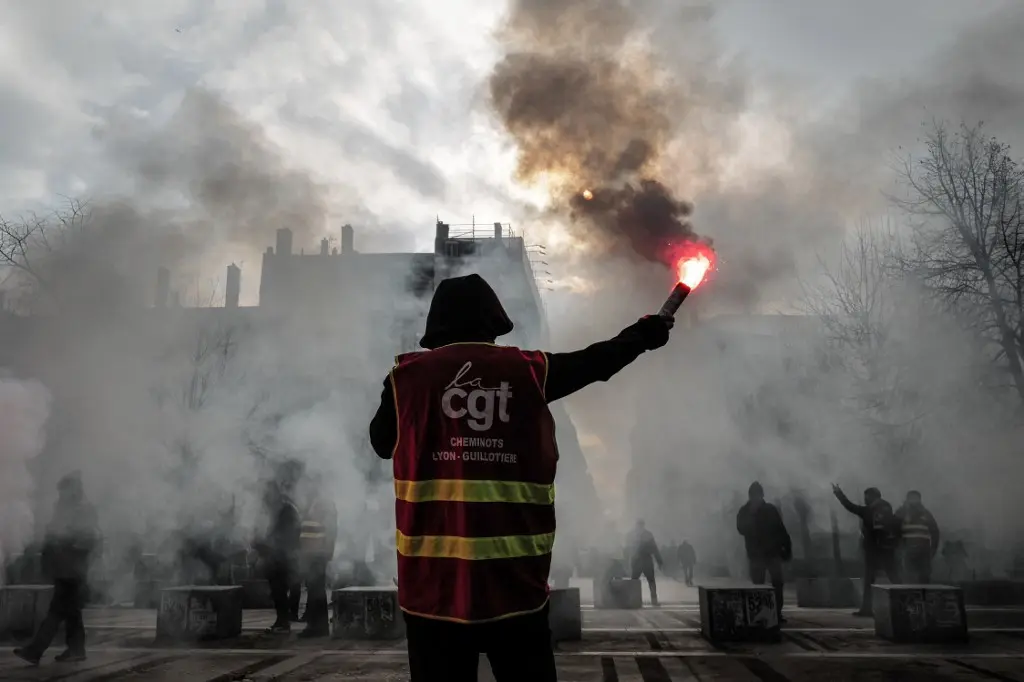
There are two types of strikes in France - unlimited or open-ended strikes that run for days or weeks at a time and single-day actions.
And if it's a one-day strike, there is a high chance that it will be on either a Tuesday or a Thursday - as we have seen with the cross-sector strike against planned budget cuts, which is scheduled for Thursday, November 5th.
READ ALSO: Calendar: The strikes and demos planned in France this autumn
This is useful to know if you're planning a trip and have some flexibility over your days of travel, but this doesn't just happen by accident.
Stéphane Sirot, a historian specialising in the sociology of strikes and trade unionism, explained to French newspaper Le Parisien that it's all about maximising turnout.
Put simply, unions declare strikes on the days when the greatest number of people are working, in order to have the highest possible number of strikers in order to heap pressure on the employers and/or government.
For this reason, weekends and public holidays are out because these days tend to have a reduced workforce. Workers who work on weekends, such as train drivers or waste collectors, often take Mondays or Fridays as rest days, so again there is a limited number of people who can strike.
There is another reason Mondays are out, said Sirot; "A sort of 'battle plan meeting' is generally held the day before a strike, in order to organise, for example, demonstration plans. However, the union leaders are not going to meet on a Sunday to refine the last points."
READ MORE: Grève illimitée or générale: 12 bits of French strike vocab you need to know
And Fridays have a further problem: "If a renewable strike starts on a Friday and a day of action is put in place on the following Monday, people working in the public sector will have four days of pay taken away, because the administration considers that they are on strike for the whole period.
"In order not to deplete the finances of strikers, unions are careful not to organise mobilisations on a Friday."
And Wednesdays? This is more of a historic reason relating to French schools giving children Wednesday afternoons off - which means that many parents also take the whole of Wednesday or the afternoon off.
These days the Wednesday half-day is less common, but it still happens so unions usually avoid Wednesdays as well - leaving Tuesdays and Thursdays the optimum strike days.
Of course, if the one-day strikes turn into une grève illimité (unlimited strike) or une grève reconductible (renewable strikes) they will encompass the whole week.
When it comes to student protests things are a little more flexible, since losing pay is not an issue for students - however demos that involve blockading their schools only take place when the schools are open, which rules out weekends and school holidays.
Demos and marches
When it comes to declared days of demonstrations, things are a little different.
You may have noticed that demos are divided into two kinds - union-organised marches in support of a strike, which take place during the week, and those organised by political parties or campaign groups which happen at the weekend, usually on Saturdays.
"Union-organised demos usually go together with strikes - which is to say the stopping of the working time. In their eyes, demonstrating on weekends is not unionism," added Sirot.
For demos that don't involve a strike, the aim is to get the largest number of people possible out on the streets, and for practical reasons that means a weekend, usually a Saturday.
Sometimes these merge into a convergence des luttes, when several different campaign groups come together - for example the 'yellow vest' marches have been planned for Saturdays, in order to maximise turnout, but have been supported by unions, some of whom have organised their own events to coincide with 'yellow vest' demos.
To find the latest on strikes and demos organised in France, head to our protest section here.
Comments