
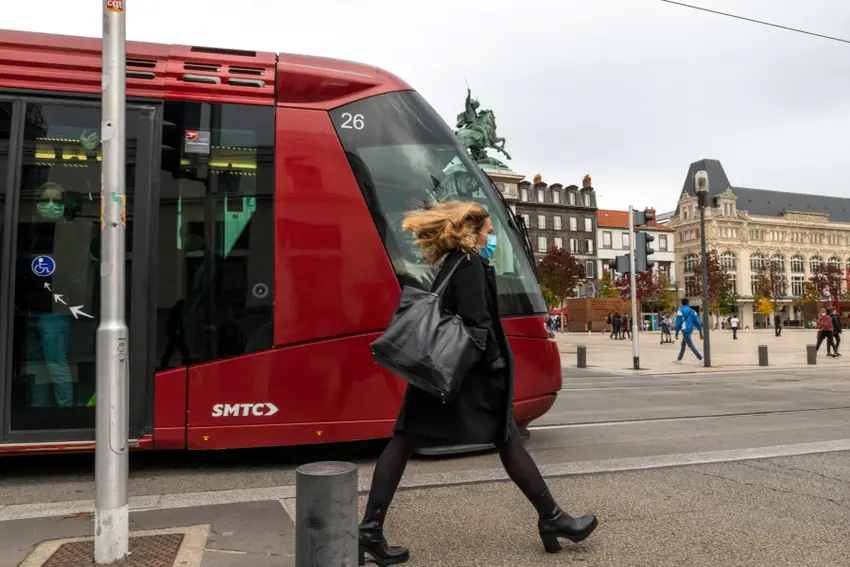
The mayor of the historic capital of Auvergne and capital of the Puy-de-Dôme département told local radio he was 'not opposed' to the idea of extending the current scheme - which allows free travel on local public transport at weekends - to take in the whole week.
"We need to find €15 million per year," Olivier Bianchi told France Bleu. "We need to imagine that this burden no longer falls on the user but on the taxpayer."
The issue, he said, would be 'at the heart of the next municipal campaign' in 2026.
Here's a look at some of the schemes in place:
Clermont-Ferrand
Public transport in in the Clermont-Ferrand metropolitan area has been free on weekends since December 2021. Now plans are being considered to extend the scheme for the whole week.
But - as stated - visitors and residents should not expect matters to happen soon. Talk of the next municipal elections puts the issue on the table for 2026, rather than any earlier.
Dunkirk
On September 1st 2018, Dunkirk became the largest European urban agglomeration to have an entirely free bus network, serving around 200,000 inhabitants.
Whether you live in Dunkirk or are just visiting, you can travel across the city for free all week long with no need for a ticket or pass.
Mayor Patrice Vergriete first promised free public transport when he was elected in 2014, but “we didn’t want to introduce the measure straight away, because the bus network would not have been able to absorb the effects,” Didier Hubert of the Dunkirk transport authority told The Local.
Instead, the council focused first on improving the service, with extended routes, services every 10 minutes, and buses which trigger traffic lights to turn green.
According to a report published in September 2019, public transport use increased by 88 percent between 2017 and 2019.
Jean-François Montagne, vice-president of the Dunkirk Urban Community in charge of ecological transition said: “If you tell your fellow citizens, ‘Take the bus, it’s good for the planet,’ it won’t work. However, if you say, ‘Take the bus, it’s free, and also it’s good for the planet,’ it works.”
Political leaders from across France, including Paris mayor Anne Hidalgo, have visited the coastal city to learn from its example.
While Montagne accepts that the Dunkirk model is not necessarily transferable – even before it became free, ticket sales only accounted for 10 percent of the transportation system’s funding, a much smaller proportion than in larger cities – he does believe others will follow.
“I really think that in 10 years, every city will have made public transport free.
"They don’t know it yet, but I’m convinced of it.”
Calais
25 miles up the coast from Dunkirk, another town has taken the plunge. Bus travel in Calais has been free since January 2020. This led to a 70 percent increase in passengers in the first months of the year, before the disruption caused by the pandemic, according to La Voix du Nord.
As in Dunkirk, the measure applies to all passengers; you do not need to show a ticket or proof of residency.
Mayor Natacha Bouchart first announced the measure in November 2018, “in response to the concerns of the 'yellow vests' in Calais,” as reported by local newspaper Nord Littoral.
Montpellier
Other cities have opted for a gradual approach. In September 2020, Montpellier in south east France first made its bus and tram network free for residents on weekends.
Starting on December 21st, 2023, public transportation will become entirely free for all Montpellier residents. However, in order to qualify, you will need to submit an application with your ID and proof of residence.
The choice to exclude visitors from the programme was a political one, according to Julie Frêche, vice-president for transport and mobility at the Montpellier Méditerranée Métropole.
“You need to be a resident to benefit from the measure, to show that, yes, we pay taxes, but these taxes go towards financing ambitious public policies,” she told The Local in June 2021.
In the immediate aftermath of the introduction for free weekend passes, the city saw an increase in weekend public transport usage by 7 percent, despite the fact that it took place during the pandemic.
Frêche also told The Local part of the goal was for public transport to help kickstart the post-lockdown economy.
“We did a study which says that 57 percent of those who made a journey at the weekend, did so because it was free,” she said.
READ ALSO Everything you need to know about taking the train in France
Niort
Located in western France, Niort introduced free public transport in 2017.
In the past six years, bus ridership has tripled, according to Les Echos.
Douai
The northern French 'crossroads city' Douai offers free public transport across the 46 communes that make up the agglomeration.
Cambrai
Another northern French town, Cambrai, has had free travel every Saturday on the entire urban transport network, since July 2022.
Nantes
In April 2021, the northern French town of Nantes joined Montpellier in offering free travel on weekends.
In Nantes, however, this applies not just to locals, but to visitors as well. The price of an unlimited travel pass has also fallen by 20 percent.
Nancy
In December 2020, the eastern city of Nancy also made public transport free on weekends.
No tickets are needed, meaning anybody can ride for free, residents and tourists alike. This applies to the bus and tram networks, as well as the ‘Citadines’, two lines of mini, electric shuttle buses which can be used for short journeys between different points in the centre of town.
The decision not to limit the offer to residents is an attempt to encourage people who live outside of the city to make the journey into town, according to Patrick Hatzig, vice-president in charge of transport at the Grand Nancy local authority.
“Our original intention was to make public transport attractive again, at a moment when Covid was leading to a fall in passenger numbers,” Hatzig told The Local.
“If it wasn’t for Covid, we would have done it anyway, but that only strengthened our determination. Covid is also an economic crisis, so helping families to come to the city centre and spend money, that has revitalised the economy.”
The council also has plans to develop 200 kilometres of new cycle lanes, and to create faster routes with buses which have priority at traffic lights. “We can only achieve all of that if we have fewer cars in town,” Hatzig said.
Niort
Residents and visitors to the Deux-Sèvres town of around 115,000 have enjoyed free public transport since 2017.
Paris
Residents of the greater Paris Île-de-France region who are under 18 are eligible for a full reimbursement of their monthly transport card. In addition, residents aged 14-18 can receive a reimbursement for the Vélib’ bicycle rental scheme.
The policy was introduced ahead of the 2020-21 school year.
Paris has talked about extending the free transport offer to more people, but as yet there are no concrete plans. Instead the city is working on expanding its cycle lane network and making more areas pedestrian friendly - according the deputy mayor David Belliard, 65 percent of the journeys that take place within Paris are done on foot.
READ ALSO: How close is Paris to its goal of being a 100% cycle-friendly city?
Amiens
The public transport network in the Somme city is free on Saturdays, while a city centre circular is free all week, children under-16 travel free, and unlimited means-tested passes are available for low-income families.
Lyon
In January 2021, France’s third largest city - which at the time had a Green Party mayor - made public transport free for certain residents. The scheme was designed to benefit 130,000 people in the greater Lyon area who are on low incomes or in vulnerable situations.
“The development of public transport is the most efficient method of reducing geographical and social inequalities,” Bruno Bernard, the then-president of the Grand Lyon urban area, said at the time.
The decision to target the least well-off sections of the population reflects a debate which is ongoing in a number of cities, including Nancy: whether free public transport should be universal, or whether resources are best directed towards those who would benefit the most.
Libourne
The Gironde town was the 13th in France to start offering limited free local public transport back in 2010. The network went totally free in 2019.
Strasbourg
In September 2021, under-18s living in the Strasbourg urban area became eligible for free travel on the CTS bus and tram network.
Since making it free for young people, the number of people subscribed to the transport network has doubled, Alain Jund, who heads mobility for the city, told Actu France in August 2023.
Lille
In January 2022, Lille began offering free public transport for all residents under the age of 18. The measure was meant to reduce a reliance on cars.
Rouen
The Normandy city introduced free public transport for school trips, for children and supervisors from the start of September 2024. Further extensions of free travel are promised in future.
One thing seems certain: we are going to see more French cities implement similar policies in the years to come.
Smaller towns in France that also offer full or limited local public transport services include: Alençon, Arcachon, Arras, Bar-le-Duc, Cahors, Castres, Chantilly, Châteaudun, Colomiers, Compiègne, Dinan, Figeac, Gaillac, Graulhet, Issoudon, Laval, Manosque, Maynnes, Noyon, Porto-Vecchio, Provins, and Villeneuve-sur-Lot.
Comments