
Golden rules can be broken. Emmanuel Macron might still be re-elected next Spring (even though the right-wing British media is already celebrating his defeat).
Marine Le Pen is unlikely to crash and burn but she is also very unlikely to be the next President of the Republic.
Assuming that it will be neither Macron nor Le Pen, then who could it be?
With just over one year to go before the first round of the presidential elections, applicants for French head of state are already forming a disorderly queue in the media.
Some have already declared their candidacy, like Xavier Bertrand, centre-right president of the northern French region region, Hauts-de-France.
Some are ostentatiously refusing to say whether they will run or not, like Edouard Philippe, Macron’s former prime minister.
Some are perpetual candidates, like the hard-left leader, Jean-Luc Mélenchon. Some clearly intend to run but are waiting for the right time, like Valérie Pécresse, president of the greater Paris region of Île-de-France.
Some dearly want to run but are trying to create the conditions for their choice by dysfunctional political families, like the Green Euro MP Yannick Jadot.
French politics has always been wonderfully confusing - shaped by the part-monarchical, part-parliamentary nature of the system.
READ ALSO Five minutes to understand how France's 2022 presidential election will work
Parties, with the partial exception of Marine Le Pen’s Rassemblement National, are weak. Personal ambitions are strong. Public patience with incumbents is feeble but eagerness to believe in new messiahs is eternal.
All of that almost worked when French politics were dominated by the old political “families” of mainstream left and mainstream right. Now things are even more confusing.
Macron (“kind of centrist”) and Le Pen (“far right in disguise”) destroyed what was left of the old duopoly five years ago when they pushed both centre-right and centre-left out of the two candidate second round of the presidential elections.
French politics is now a game invented for two which is played by four. Imagine a chess board with four sets of pieces or boxing with fighters in all corners of the ring.
Add to that the fact that the “centre-right” and the “centre-left-greens” are not monolithic movements, dominated by one strong party or leader. They are permanent family quarrels, driven partly by ideology, mostly by personal ambition.
Add, further, the worst pandemic for a century.
Add, also, the plague-on-all-politicians mood of rural and suburban France revealed by the Giles Jaunes (yellow vest) movement and now also common amongst the urban young.
Predicting the outcome - even the general shape - of the election next April and May is a gloriously hazardous enterprise. Here, all the same, is an attempt to sort the plausible from the impossible, in four questions.
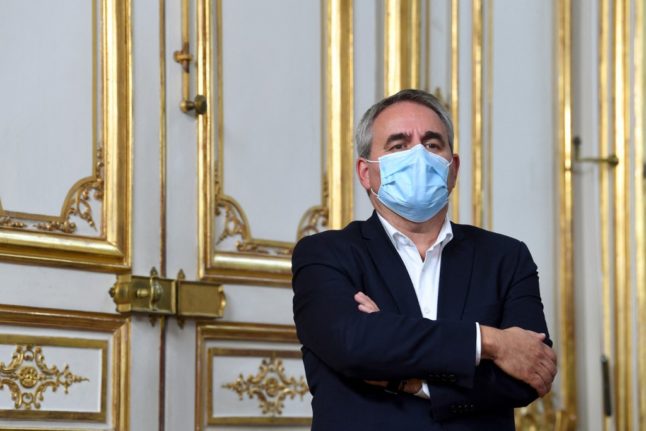 President of France's Hauts-de-France region and former Health Minister Xavier Bertrand. Photo by Alain JOCARD / AFP
First question
Should we take Xavier Bertrand, president of the north, as seriously as he takes himself?
Late last month, Betrand jumped the gun on his centre-right rivals and declared himself to be the spiritual successor of Charles de Gaulle and “a candidate for all of the French people”. He would run an independent campaign he said, and ignore any primary which may or may not be organised by the main centre-right party, Les Républicains, in October.
Bertrand pledges to govern partly by referenda, borrowing one of the demands of the Gilets Jaunes movement. He says he stands for “regionalism, not Parisianism” (The GJs again). He promises to be tough on crime and terrorism (reacting to the exaggerated picture of a violence-wracked France presented by right-wing media).
He says he is not an “investment banker” (Macron) nor an “heiress” (Le Pen) but a small-town insurance agent from Flavy-le-Martel in Picardy who found himself swept into politics, lost his way for a while and has now discovered that he “comes from the people”.
This careful positioning or pretence - “Monsieur Bertrand goes to Paris” - disguises the fact that he held ministerial positions for 9 years; that he was a member of parliament for 12 years; and secretary general of the main centre-right party for two years (divorcing two wives along the way).
“Bertrandisme” is a re-heat of the something-for-everyone, do-very-little politics which allowed France to drift aimlessly though much of the 1990s and early 2000s. But unexciting and familiar is perhaps what many French people will settle for next year after the bouleversements of the Covid epidemic - neither a new revolution (Le Pen) nor an unfinished revolution (Macron).
Could Bertrand pip the President to a place in the two-candidate second round? His first, post-declaration opinion polls are poor. If he finds himself pulled into a scrap within the diminished centre-right, he will have lost his gamble. He needs rapidly to emerge as the “third man” alongside Macron and Le Pen.
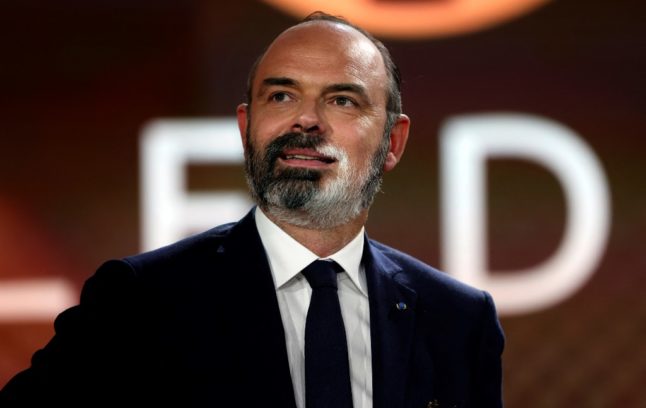 Mayor of Le Havre and former Prime Minister Edouard Philippe. Photo by Thomas COEX / AFP
Second question
What is Edouard Philippe up to?
Macron’s former prime minister is now the most popular active politician in France. He is published a book on Wednesday on his experiences as PM. He has been doing a round of media interviews in which he coyly fails to say whether a) he will run for President or b) he won’t run for President.
The Elysée believes that he will not - so long as Macron plans to run. If the President decides that he has little chance of re-election - if say the Covid pandemic fails to respond to treatment - Philippe could be his agreed substitute.
The danger for Macron is that other people might try to make that decision for him. The president’s popularity, 38 percent or so approval, is the highest of any late term French president for more than three decades. If that collapses, Philippe could emerge as the figure-head of a delegation of the great and good advising Macron to stand aside.
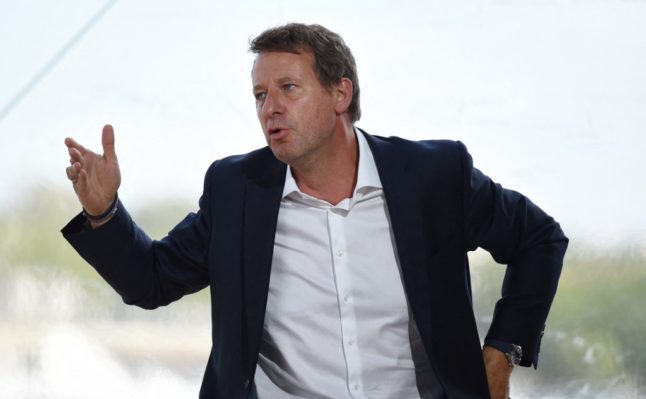 European MP of EELV (Europe Ecology The Greens) Yannick Jadot. Photo by Eric PIERMONT / AFP
Third question
What on earth is happening on the centre-left?
Yannick Jadot, Green Euro MP and one of several possible green presidential candidates, has called for a meeting later this month all the parties, movements, tribes and fragments of the left and the greens to discuss a single presidential programme and a way of choosing a single candidate.
Great idea. Any chance of success? None whatsoever. Mélenchon’s hard-left La France Insoumise, which has the biggest chunk of leftist support, has made it plain they will go it alone. Other figures in the green movement accuse Jadot of trying to by-pass the green primary planned for September.
The prolonged suicide of the French Left continues.
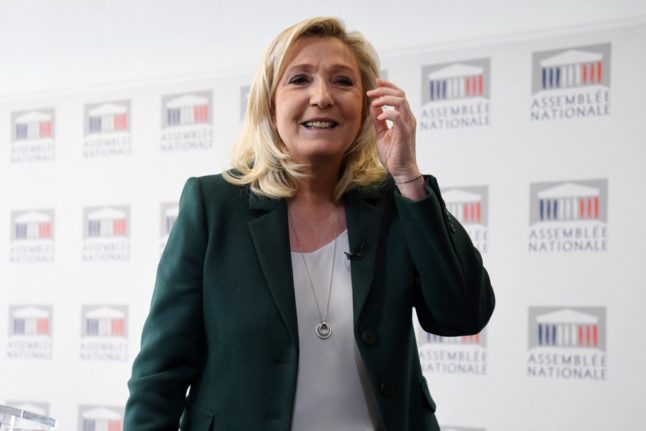 President of the French far-right party Rassemblement National Marine Le Pen. Photo by Alain JOCARD / AFP
Fourth question
Can Le Pen beat Macron if, as still seems possible, both reach the second round again? Recent long-distance opinion polling puts the far-right leader as high as 48 percent, compared to her 34 percent score in 2017. And yet her own personal rating, in the low 30s, are poorer than they were five years ago.
The numbers add up only because a section of the French left, though unable to produce a convincing candidate or coherent programme of their own, has convinced itself that Macronisme is as evil as Lepennisme. Left-wing voters especially young left-wing voters, say they will abstain en masse in a Le Pen-Macron run-off
Will they? Yes, I expect that many of them will though perhaps not as many as say tell the pollsters that they will.
A re-run of the 2017 run-off would be an unpleasantly close run-thing. I believe Macron would win. But if the president’s ratings slide this summer and the potential match-up with Le Pen becomes hazardous, the grey men in grey suits might call at the Elysée.
They would suggest that, for France’s sake, Macron should allowed the vastly popular Edouard Philippe a chance to become President of the Republic (and become instantly unpopular).
I am not saying this will happen. I’m saying it could happen.
As things stand, my money would be on Macron. If it’s not him, it will be because he decided not to run or lost in the first round.
I do not believe that the French people, however perverse, or the French election system, however muddled, will produce a President Marine Le Pen.
Comments (1)