
Even though eyecare is generally not cheap in France, there are free and reduced-price options available.
Before 2020, more than one in 10 French people gave up buying prescription glasses for financial reasons, with the lowest earners the most likely to be affected.
However, in 2020 the '100% Santé' reforms came into force, and they help cover the cost of a range of healthcare items, from prescription glasses to dentures and hearing aids.
After the scheme came into effect, lenses for a range of conditions and a small selection of frames up to €100 became fully covered via social security and mutuelle (complementary or top-off health cover) firms.
READ ALSO Health insurance in France: What you need to know about a mutuelle
This means that people who are registered with French social security and hold a top-off insurance scheme are able to get a pair of glasses at zero cost at the point of need.
Before the reforms, the average price for a pair of glasses with single-vision lenses was €290, including €135 for the frames. Social security cover and the commonly held mutuelle complementary health cover in France paid for 78 percent of that cost, or €225, leaving people at least €65 out of pocket.
How to benefit from the scheme
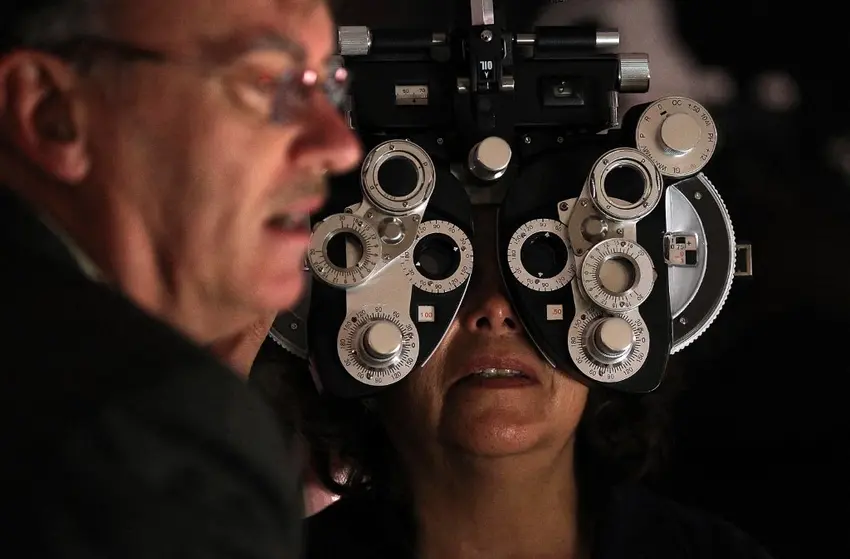
Patients must have a prescription. Be aware, however, that it can take some time to get an an appointment for a full eye test with an ophthalmologist or other eyecare professional (below).
You can book appointments online, either with the service Doctolib, or using the health ministry approved site 'LeMedecin.Fr'.
Appointments can also be made by phone, and to find the registered doctors in your area you can consult the Ameli website.
Once you have a prescription, it lasts for three years for anyone aged 42 and over, five years for adults under the age of 42, and one year for children under 16.
Meanwhile, to cut waiting times, you can also get your eyes checked if your existing prescription is still valid, either with an orthoptiste (if you're between 16 and 42 years old) or an optométriste. That said, you should see an ophthalmologist if you've had serious changes in your vision.
Which glasses count under '100% Santé'?
This is the important part. When you enter a glasses shop, those that are covered under the '100% Santé' plan may not be immediately visible, even though opticians are required to display lower cost frames (montures).
Standard lenses and frames covered by the scheme are under the 'Classe A' category, whereas items under the 'Classe B' category are freely priced (prix libre). The quality of the lens (verres) should be the same between A and B.
Be sure to tell the optician that you are looking for 'Classe A' items when testing out glasses, otherwise you might be unknowingly testing out expensive pairs that are not covered.
Usually, it is possible to combine buying 'Classe A' lenses and a 'Classe B' frames. That said, you would have to pay the rest out-of-pocket, depending on how much your mutuelle covers.
Most frames covered by the 100% Santé scheme cost €30 or less.
But if you want more expensive frames or varifocal lenses, these pricier options can still be partially covered by French health insurance.
READ ALSO How to get a carte vitale in France and why you need one
Additionally, most mutuelle insurance schemes allow a pair of new glasses, or replacement lenses, every two years – useful, as lenses made of plastic can scratch easily.
If you do not like the 'Classe A' options, you can check your contract with your mutuelle to see the amount it would cover. If you opt for both Classe B lenses and frames, you will not receive assistance from French social security, but your mutuelle might pay for a portion.
In many cases, the mutuelle will allow you to simulate what would or would not be reimbursed. The contract should show how much they would cover for a combination of 'Classe A' and 'Classe B' items, as well as only 'Classe B' items.
You can ask to help you do this with the optician before deciding to buy a new pair.
What about contact lenses?
According to the Sécurité Sociale website, contact lenses are reimbursed at a rate of 60 percent based on their fixed annual price of €39.48 (as of 2025) per eye fitted. More info here.
This is the standard regardless of the type, ie. if they are reusable or not.
Comments