
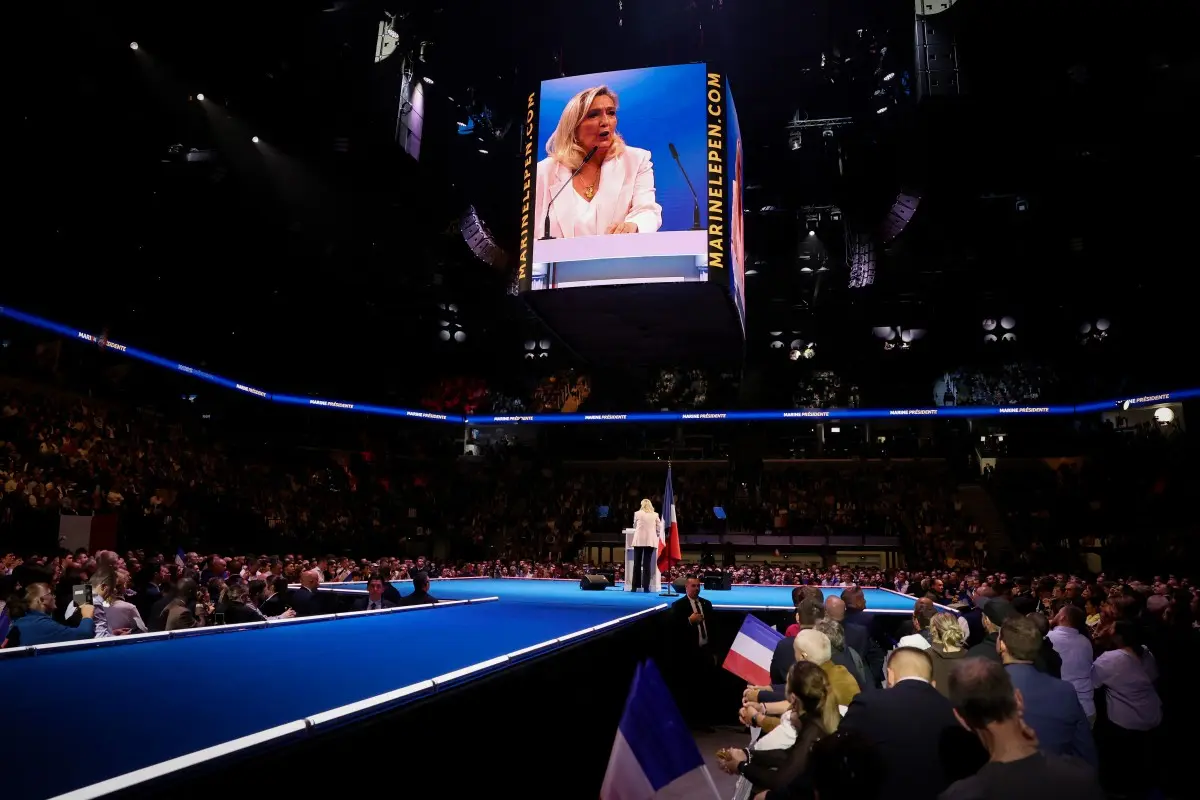
Marine Le Pen this weekend formally launched her presidential bid, aiming to capitalise on the widespread violence and looting that accompanied protests on October 17th by promising to "restore the rule of law".
"Who can claim that there is a rule of law when hordes come to ransack and burn our buildings?" the convicted embezzler told supporters at the party congress.
The congress took place in Orléans, the town most associated with Joan of Arc, who has long been claimed as a symbol by the far-right (poor Joan, like being burned alive by the English wasn't bad enough), and also re-elected Jordan Bardella as party president with 98.98 percent of the vote.
This is our weekly column looking at all the latest from the presidential race - if you don't want to miss it and if you want to read it first, just go to your newsletter options and subscribe to the '2027 presidential race' alert.
Le Pen also promised to add the notion of la communauté nationale - the national community - to the French Constitution, a continuation of her policy of 'French preference' that would see legally resident foreigners excluded from certain jobs, housing and benefits. As part of this policy, the RN parliamentary party has proposed an amendment to next year's budget that would tax businesses an extra €1,000 per year for every worker they employ who is not a citizen of an EU country.
Language
When condemning the les hordes who vandalised and looted on October 17th, Le Pen herself was careful to avoid overtly racist language, although many others on the right were not so restrained.
And it appears that at least one person was listening - on Friday, the Paris suburb of Trappes was the target of an appalling attack that saw a man drive through the town shooting at passers-by, apparently targeting people of colour. A 26-year-old local man has died and five others, including a 12-year-old girl, were badly wounded.
The shooter, who seems to have severe mental health problems, told police that he wanted to "avenge" the shopkeepers whose stores had been looted.
Anti-terrorism police have taken over the case and have launched investigations into 'murder and attempted murder in connection with a terrorist organisation, where the offence was committed on the grounds of actual or supposed membership of a particular race, ethnic group, nation or religion'.
The polls
We've also had time for some in-depth polling as the dust settles after the widespread violence and looting that accompanied protests on October 17th - and it's not giving Le Pen the bounce that many predicted.
Polling by Ipsos for newspaper Le Parisien shows Le Pen maintaining her strong lead, but not gaining voting intentions in the aftermath of October 17th. Far-left leader Jean-Luc Mélenchon also suffered no polling damage, despite a concerted effort to blame his party for the violence.
The block most affected is the centrists, with both Edouard Philippe and Gabriel Attal showing a significant drop in their voting intentions, with polling now suggesting that the two with the highest votes in the first round would be Le Pen and Mélenchon.
A dual between these two in the second round is widely regarded as a slam-dunk victory for Le Pen, since if there is one person that centrist voters hate more than her, it's Mélenchon.
The left
And Raphaël Glucksmann, winner just last week of the primary of the centre-left and greeted with some excitement, especially in the foreign media, as the hope of moderate voters? He seems to have been strangely absent from the debate, to the extent that someone has created a 'missing' poster in the style of those for a lost dog.
Attentifs ensemble
— Klaire fait Grr (@klaire.fr) 26 October 2026 at 07:31
[image or embed]
He himself says he has been the victim of a "campaign of harassment" by members of La France Insoumise, which has prevented him from organising campaign events, a charge that LFI denies.
The question now is whether the febrile mood of the country will calm and allow for a more normal election campaign, or whether the tension and sporadic violence is here to stay.
Possibly one of the more worrying developments over the weekend was the small groups of far-right supporters who emerged onto the streets to take on the far-left casseurs on the margins of the demos in some towns, notably Nice.
Before we get too dramatic, these brawls were very small and limited, comprising a few dozen people at most.
But the spectre of street fighting between gangs of the far-right and far-left is a haunting one for France, bringing reminders of the turbulent 1930s.
More candidates
We also have two new candidates now declared, because if there's one thing this election was short of, it's declared candidates - the newcomers are Cannes mayor David Lisnard and journalist Natacha Polony.
Lisnard is a right-winger who has recently quit the Les Républicains party and is pitching himself as a centre-right candidate, disturbed by LR's rightward drift which he sees as painting the party into a corner, while Polony is a former staffer at the left-wing magazine Marianne whose pronouncements so far focus on "fighting France's decline".
While Lisnard may be able to count on some supporters in his former party, it's seen as unlikely that Polony will be able to secure the required sponsorship from at least 500 elected officials under France's parrainage system.
This is our French Presidential election column, which we will be publishing weekly between now and the election in April and May 2027 (maybe with a break over Christmas). To receive it as an email, just go to your newsletter options and subscribe to '2027 presidential race'.
Comments (2)