
A year after the race's most southerly start in Barcelona, the Scottish capital will surpass the 2022 Grand Depart in Copenhagen in the opposite direction, as for the fifth time in six years, the men's Tour sets off from abroad.
The Edinburgh start had been known for more than a year and the first three stages in Britain - in Scotland, England and then Wales - were revealed in January.

But organisers ASO published the full route on Thursday, with two individual time-trials and a closing stage around Paris taking on the already iconic Montmartre climb for the third year running.
That is sure to whet the appetite after the last two years produced thrilling finishes, with Belgian Wout van Aert taking the victory in 2025 and Mathieu van der Poel, with a bit of help from overall winner Tadej Pogacar, holding off a charging peloton by inches back in July.
But long before the peloton arrives there for the finale of the 114th edition of the Tour - and even before it reaches the high mountains - there will be plenty of opportunities for cycling's renowned "puncheurs" to take centre stage in the first part of the race.
"Wales is Liege-Bastogne-Liege," Tour director Christian Prudhomme told AFP about the third stage in 2027, in reference to the famous hilly spring one-day classic.
"The first 10 days are designed to keep the jerseys changing hands - the best puncheurs in the world against the overall favourites."
The best in both of those categories is Pogacar, but the course design aims to avoid a repeat of the 2026 edition when the Slovenian great - who will be bidding for a record sixth yellow jersey victory - held the lead almost from beginning to end.
Prudhomme said he wanted "to muddy the waters, to have a route which allows for anything to happen".
Riders will face a windy arrival in France on the Cotentin peninsula in Normandy, with a fourth stage largely ridden along the coast.
Even before the first mountain challenge on stage nine, finishing on the Grand Colombier in the Jura range, the sprinters will struggle to find too many days that favour them.
Terribly steep
The first time-trial is on stage seven and at 38km and pancake-flat, it should leave Olympic and world champion in the discipline Remco Evenepoel salivating.
He finished second to Pogacar in July but the early part of the 2027 edition should give him a great chance to steal a march on the Slovenian before the mountains begin.
A second time-trial of 33km around Toulouse on stage 16 should again favour the Belgian.
There will be no shortage of mountains, though, with 28 climbs and a total elevation gain of 53,450m, but just three summit finishes among six mountainous stages.
The highest point will be the Col du Portet in the Pyrenees on stage 18, topping off at 2,215m above sea level.
But there will be no Alpe d'Huez, Ventoux, Galibier or Izoard in 2027, although the Tour will take on the Tourmalet and pass through Domancy, where the world championships will be held the following month.
"If you want to discover other climbs, you have to accept that we don't systematically use the best-known ones," said Prudhomme.
"It's the first time that we will link the Tourmalet and the Portet -- two monsters -- and the next day there will also be terribly steep ascents with the return of the Basque climbs Burdincurutcheta and Bagargui for the first time since 2023."
Curiously, though, the 20th and penultimate stage is designed for the sprinters, meaning that the Tour should be sewn up two days before the Montmartre excitement in Paris.
For more information on each stage of the 2027 Tour de France men's race click here.
Tour de France Femmes 2027
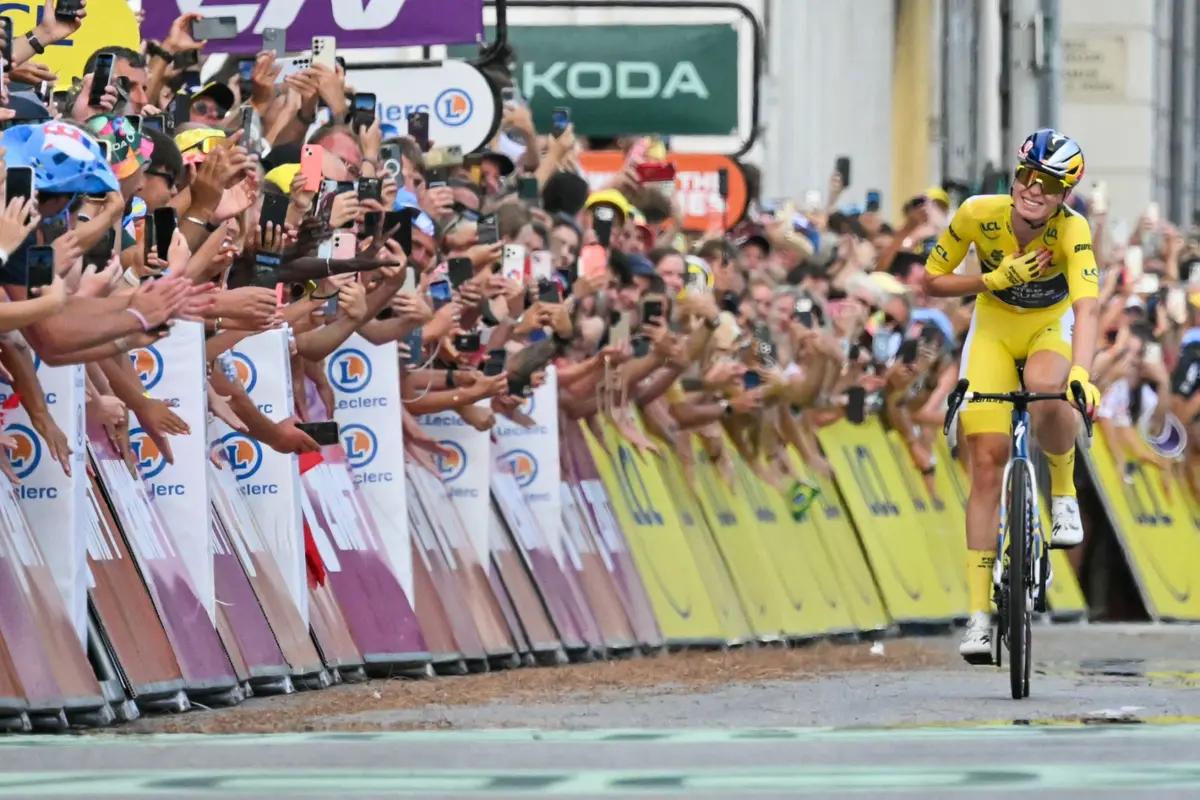
The 2027 Tour de France Femmes, which begins in Leeds, England will end on the Puy de Dome volcano, organisers ASO revealed on Thursday.
The nine-stage race from July 30 to August 7, 2027 will include the first three stages in England, including the race's first ever team time-trial, which will pass in front of Big Ben and Buckingham Palace in London.
But it is the finale on the tough Puy de Dome at the end of the race's longest stage over 170km which will be the key to the action.

"Every year, we try to find a mountain which has an iconic place in Tour history," race director Marion Rousse told AFP.
The brutal 11.3km-long climb with an average gradient of 7.8 percent made its return to the men's Tour in 2023 for the first time in 35 years.
Its inclusion continues a trend in the women's race of including one of France's most famous climbs in each edition -- Super Planche des Belles Filles in 2022, the Tourmalet in 2023, Alpe d'Huez in 2024, the Col de la Madeleine in 2025 and Mont Ventoux in 2026.
"With its final four kilometres at more than 12 percent, we know that anything could still happen on that last climb," said Rousse of the Puy de Dome.
That has been the case in the women's race with thrilling final stages in recent years, with Kasia Niewiadoma winning by just four seconds in 2024.
The 2025 and 2026 editions won respectively by Frenchwoman Pauline Ferrand-Prevot and Dutch rider Demi Vollering provided dramatic finales.
It will be the culmination of a tough fifth edition of the race.
"The Grand Depart is the toughest in history and the first three stages will be crucial for the overall standings," said Rousse.
"The (second) stage to Sheffield already has more than 3,000m of elevation gain. After that, it's a classic every day."
For more information on each stage of the 2027 Tour de France Femmes race click here.
Comments