
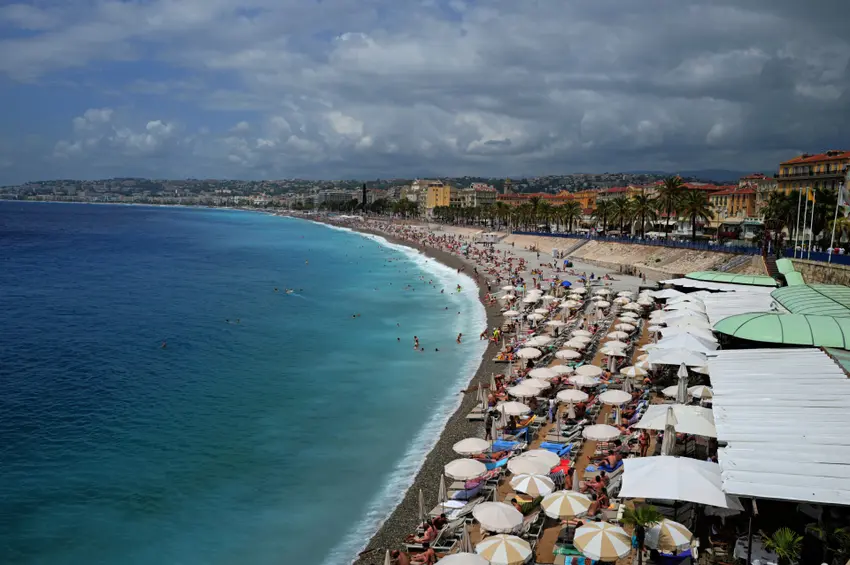
Strategic towel placement does not guarantee day-long sun lounger rights. In most cases, the Rule of the Towel has no legal authority for French beach loungers, and – legally, at least – first-come, first-reserved means nothing on a beach, by a hotel pool, or even in private establishments.
There is, however, some variation depending on exactly where you are.
Hotel swimming pools and beaches
Hotel or private beach area staff can clear unoccupied loungers of items left on them so they are available to be used by others.
You may see lounger clearance sweeps happen increasingly often at hotels or on private beaches, after a German court in 2024 ordered a holiday operator to compensate a family who complained after they had been unable to secure sun loungers at their hotel during a holiday in Greece.
As well as removing towels, hotels or private areas on beaches can also impose time limits on lounger occupancy and / or implement some form of reservation system.
Where these provisions are not in place, in theory, you would be in your rights to remove a towel left on an unattended lounger. Before doing so, however, and to avoid poolside contretemps, make sure that the towel’s owner is not swimming laps in the pool.
READ ALSO Sand, smoking and sex: The rules you need to respect on French beaches
No one wants an argument, so it might be better to talk to staff at reception: many hotels now have a “sun lounger patrol” or internal rules prohibiting advance booking. Some remove towels left unattended after a certain period.
Request that the house rules be enforced: if it is stated in writing that sun loungers cannot be reserved, the hotel must ensure the rule is upheld.
Document the situation (photos, times, absence of people) if the hotel refuses to take action.
Private beach
At venues where guests pay a fee to reserve a lounger, it’s theirs for the duration - this usually happens on the sections of 'private beach' that you will find on French beaches.
These are sometimes attached to hotels, but not always, and many are open to the general public.
You pay a fee to reserve a deck chair, sun lounger or a lounger-parasol combo and then it's yours for the duration.
Some of these are attached to a café or beach-bar and also offer drinks and snacks, delivered to your sunbed for maximum laziness/relaxation.
Public beach
Most beaches in France are public, and most of these do not offer sun loungers - so it's up to you to bring your own chairs, loungers, towels, parasols or whatever you want to make your beach trip comfortable.
These are of course your own private property and can be used as you like - although you should not leave them overnight, they will likely be cleared away by the municipal beach cleaners.
What's the deal with public v private beaches in France?
French Coastal Law clearly states that access to beaches is free and open to the public, although restrictions may be imposed for reasons of safety, defence, or environmental protection.
But, local authorities can subcontract specific areas to hotels, beach operators or water sports equipment rental companies. They then get to legally rent a certain space and can install loungers and charge people to use them.
There are currently around 1,500 private beach areas in operation along the French coastline, and they are most common along the Riviera and Mediterranean coast.
Because access to the sea is open to the public, these private beach areas are supposed to stop at least 3 metres short of the sea, although this isn't always enforced.
READ ALSO Beaches in France are public by law, so why are there so many private ones?
On public beaches, local councils can – and do – issue by-laws to ensure fair access to public spaces.
If the beach is cluttered with ‘ghost’ beach gear, users can:
- Report the situation to the local police;
- Ask whether a local by-law exists. Some prohibit setting up before a certain time;
- Contact the local council, if the situation becomes a recurring problem.
Comments