
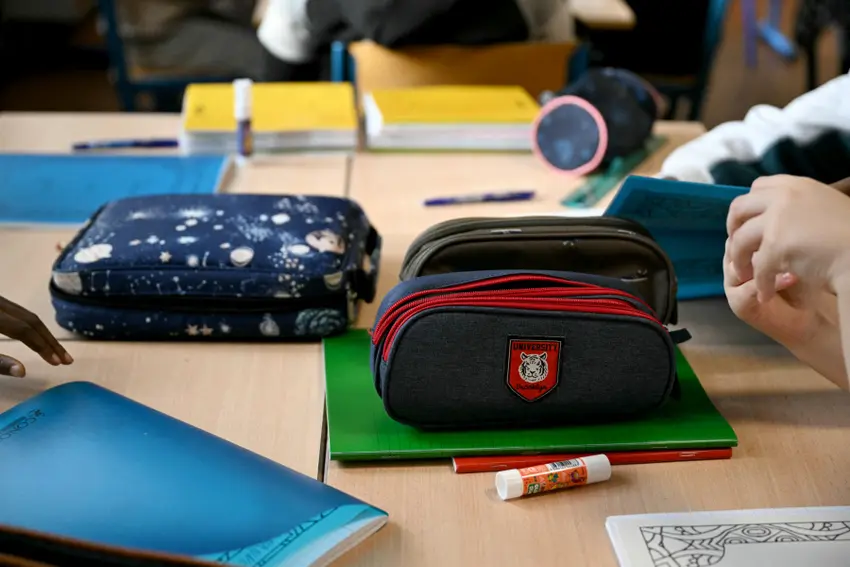
Two words to strike fear into the hearts of any parent of a school-age child living in France: fournitures scolaires.
It’s finally the summer holidays: eight weeks of respite from school drop-offs, homework supervision and nit checks … but one small admin challenge lies between every parent and their sun lounger: the school supplies list, aka the world’s least fun summer treasure hunt.
What is the liste de fournitures scolaires?
Every year, a few days after the end of the summer term, and usually starting as your child heads into CP (cours préparatoire - which children usually start at the age of six), their school will send out a list of the supplies they will need for their new class in September:
The list is mostly made up of stationery and classroom equipment, but often a regulation backpack or satchel, and items such as an overall or old shirt to protect them during art classes, and boxes of tissues for the classroom: a nod to the many colds they will share in the coming months.
The government publishes a model list that schools are supposed to refer to when compiling their own requirements.
READ ALSO: The 17 items of stationery that schoolchildren in France should have
Schools are supposed make sure their lists are “reasonable”, to limit the financial cost of education for families and to avoid the danger of social stigma for pupils whose families cannot afford everything they need, not to mention encouraging environmentally responsible behaviour and avoiding waste.
As someone who once had to buy five erasers for a child going into grande section (five year-olds) I can safely say this isn’t always the case. (I’m a child of 1980s Britain and I think my one stripey eraser from a National Trust gift shop lasted my entire school career.)
Some years, our school lists have honestly made me wonder what dirt Big Stationery has on the ministry of education.
One year, we had to supply eleven glue sticks. “We stuck things,” was my daughter’s reply, when asked what she’d done on the first day of school–so I suppose at least they do seem to use them.
Financial support for lower incomes
While the bad news is that many schools’ lists seem to stray quite far from the basic requirement, the good news is that financial help is available for those that need it: all those glue sticks don’t come cheap.
Families on low incomes qualify for help via the Allocation de Rentrée Scolaire (ARS).
This is a payment made by the CAF to qualifying families of children aged between 6 and 18 years old, whether they are at school (public, or “sous contrat” or partially state-funded private schools), in higher education, or doing an apprenticeship.
For 6-10 year-olds, the payment is €426.87, € 450.41 for 10-14 year-olds and 15-18 year-olds get €466.02.
If you’re already registered with the CAF, the payment should arrive automatically on August 18th, but you can find out more about how to apply on the CAF website.
At some schools, the parents’ association (association des parents d’élèves or APE) may in some cases also be able to provide financial help to families that need it, while local authorities may also provide assistance, or vouchers. You can try asking your local mairie or looking on the website of your département or région.
Where to buy your supplies
Whatever your budget, it’s good to keep the stationery costs down.
It’s always a good idea to start by doing an inventory of what is left over at the end of the year and will still be OK for next year, but in my experience it’s usually not much.
Supermarkets hardly wait for the summer term to be over before launching their rentrée offers, and in bigger outlets you’ll usually find a well-stocked section full of different sized notebooks, folders, binders and the rest.
Look out for promotions on school items over the summer but (from bitter experience) even if your thoughts are turning more to plage than papeterie, it’s really best not to wait until August 30th to start buying, as stocks do run out.
Some parents’ associations or schools themselves also organise grouped orders (packs fournitures) to bring down costs, so this is something it’s worth checking with your school about, before you start tracking down the individual items.
School list services
If you’re lucky, your school may have posted its list to one of the online sites, such as rentreediscount.com or scoleo.fr that offers a school list service. This simplifies things even more. You simply search for your school and class on the website, and if it’s there, you can order everything at once.
Even if your school’s list is not available, some online retailers, including bureau-vallee.fr, offer an automated school list service. You just upload your school list, make any tweaks to the list the site generates, and then place your order for home or store delivery.
Some independent stationery shops offer a “préparation de liste scolaire” service done the old-fashioned way – just take in your list and they will put it together for you: no stress.
Know your papier calque from your papier millimetré
(That’s tracing paper and graph paper, for the uninitiated.)
If you’re opting to buy all the supplies individually yourself, some of the vocabulary on the list can be quite baffling–even if you plan to shop in person, doing an online search in French for the required items so you know what to look out for can be a useful first step.
Requirements are usually extremely specific – notebooks must have the right dimensions, with the right number of pages, and with the correct type of squares or lines and for the all-important mastery of cursive handwriting, pens need to be the right type (stylo à bille or stylo plume), with the right sized nib.
Having been through the school list challenge quite a few times now, I would say that, if nothing else, it’s a good exercise in expanding your French stationery vocabulary.
Comments