
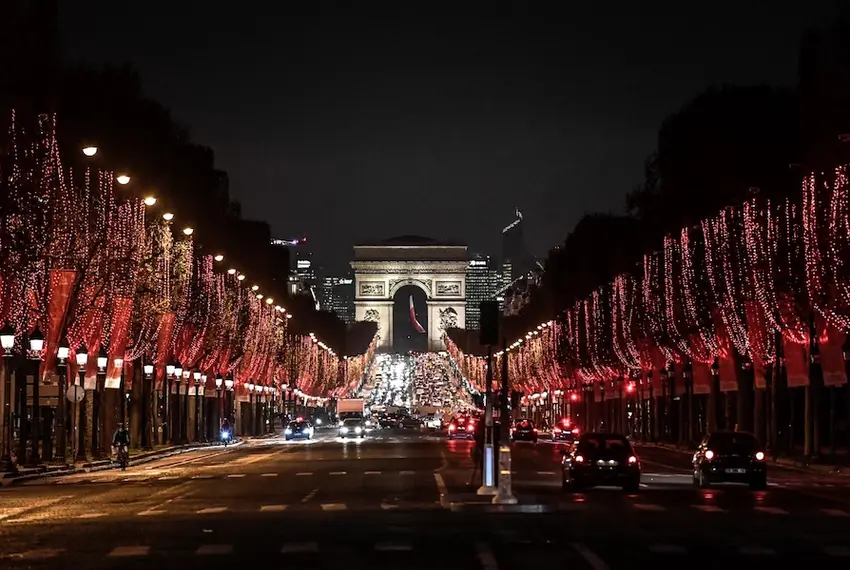
Paris' Champs-Élysées Avenue is nearly two kilometres long, running from Place de la Concorde, where King Louis XVI and Marie Antoinette lost their heads, to the Arc de Triomphe monument at the other end.
The avenue dates back to the 17th century, when the gardener to the Sun King (Louis XIV) first traced its path.
It has witnessed important events in France history. In 1940, German troops marched along the avenue following the fall of Paris, and in 1944, General Charles de Gaulle and the French 2nd Armoured Division paraded down the Champs-Elysées to celebrate the liberation of Paris.
It's a key site for French sports too - the Tour de France traditionally ends there, the avenue was the site of the farewell parade for the 2024 Olympics and if a French national team wins, fans traditionally pour onto the street to celebrate.
Less peacefully, in 2019 Gilet Jaunes protests erupted along the avenue with luxury stores smashed up and the Arc de Triomphe defaced.
While the avenue remains a key symbolic site for the city, in recent years it has begun to lose residents, while commercial rents have skyrocketed.
So what's gone wrong?
The emptying out of the avenue
Only a couple of dozen full-time residents remain on the street itself, and the cultural centres and middle-income shops which once brought Parisians to the avenue have left.
Listen to the team at The Local talk about how the Champs-Elysées have changed over the years in our latest Talking France episode.
Since the early 2000s, the number of luxury boutiques has increased 30-fold, according to French news outlet TF1, to the point that now they represent a quarter of shops along the avenue.
With prices high, it is difficult for smaller, more middle-income shops to stay afloat. Cultural centres, like cinemas, have also had to close down.
In June 2024, the UGC Normandie cinema, which had been on the avenue for almost 90 years, became the third cinema to close its doors in four years.
Earlier this year, the FNAC, which was a staple electronics and entertainment shop on the avenue, closed its doors after almost three decades.
When the UGC Normandie cinema shut down, Ronan Guevel, who has lived in the area for 20 years and chairs a neighbourhood association, told Franceinfo that "Shops catering to Parisians are being replaced by brands that have stores all over the world. The Champs-Élysées is losing some of its soul.
"When I was a teenager, my friends and I used to go out to the Champs-Élysées. We loved going to the cinema. There must have been seven or eight of them on the avenue."
The Local's politics expert John Lichfield has a similar observation. "I think that Parisians gave up on the Champs-Élysées long ago. It has become the high street for visitors. The cinemas have now more or less disappeared, which was one of the things that used to bring Parisians to the Champs-Élysées.
"It has become the high street, a parading place for visitors. In some ways, it is better than the 1970s, but I think it is on a downward path now because it has become too crowded with similar kinds of shops that are not special to Paris."
READ MORE: Readers reveal: The most disappointing tourist sites in France
Meanwhile, the mayor of the 8th arrondissement of Paris, Jeanne d'Hauteserre, told Le Monde that now "only major luxury brands can maintain a foothold".
According to Franceinfo, the annual commercial rental price on the avenue was at least €15,000 per square meter, as of 2024. Compared to a typical Parisian street, this is, on average, 50 times higher and likely to continue climbing.
French daily Le Monde found that Qatar - or rather Qatari families or investment funds - currently own 20 percent of the property on the Champs-Elysées.
As the avenue has become a place for the wealthy to invest, it has also lost many of its residents, with a 10 percent increase in vacant homes since 2006, Le Monde reported.
Le Monde reported that only 90 people were listed on the town hall's electoral roll, as of 2025.
In the surrounding area, known as the 'Golden Triangle' - the area between the Avenues of the Champs-Élysées, Montaigne, and George V - only has 2,000 people listed on the electoral roll.
Meanwhile, Paris's 8th arrondissement overall comes in first place in the city for the most vacant homes. Over a third of residences - 36 percent - are sitting empty, either because the owner has chosen not to live there, it is between renters or owners, or because it is a second home.
READ MORE: Why does Paris have so many empty homes?
The Paris Urban Planning Agency found that over half of the residential property owners along the Champs-Élysées owned five or more homes.
The organisation told Le Monde that the rise of vacant homes in this area was a result of real estate investment and the growth of furnished tourist rentals.
One resident, a man named Serge who lives on Rue de Ponthieu (one street over from the Champs-Élysées), told the French daily: "It's a business district; everything is closed on weekends. There are no local shops, no butcher..."
For locals, this has also meant that there is only one primary school left in the 'Golden Triangle' area, and enrollment has dropped, forcing the school to close one of its classes in 2024.
Any change on the horizon?
While it may not bring residents back, Paris mayor Anne Hidalgo in 2021 announced plans to turn the avenue into "an extraordinary garden".
Last year, the Comité des Champs-Élysées outlined its plans (to the tune of €250 million) in a 1,800-page study.
From increasing pedestrian space by 13 percent by widening sidewalks in the upper part of the avenue, to reducing the number of car lanes from six to four, doubling the width of cycle paths, and adding more free restrooms and shaded seating areas, the avenue is set to have a different appearance in 2030.
Still, it remains to be seen whether this will bring back the Parisians.
Comments (2)