

In France, there are several options for those looking to rent a vehicle.
While you can opt for classic rental car agencies such as Europcar, Ada, Sixt, Alamo, Hertz and Enterprise, they tend to be a bit more expensive than alternative options and less flexible for those planning last-minute trips.
Often, the classic rental car agencies are located at major train stations and airports, so you would need to travel there to pick up the vehicle.
While this may be convenient for those already travelling, alternative rental car options might be located directly in the city or town you are visiting.
Renting from an individual
Companies such as Turo, Getaround, Ouicar and Free2Move allow users to rent from an individual. In these situations, you download the smartphone app (or go onto the website) and create a profile.
Generally, these apps ask you to upload your driving licence (a non-French licence ought to work) as well as a means of payment and a proof of identity (for example, scanning your passport and taking a picture of your face).
They operate similarly, usually showing you an interactive map with the rentable vehicles nearby, with their prices and reviews. You can also see which cars are currently available if you want to simply rent the vehicle for a few hours.
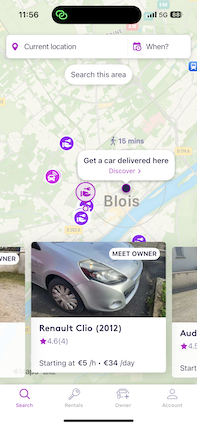 A screenshot of the Getaround app
Individual rental car services usually either allow you to pick up the keys directly from the car's owner, or they might have a special connected service on the app or a nearby keybox that allows you to get the keys directly at where the car is parked.
Because these rentals are directly from an individual, this option might not be suitable for people who speak no French.
Price comparison
In large cities, the prices of individual rental services are roughly comparable to those of larger rental companies.
For example, let's say you wanted to rent a car from the weekend of April 24th to the 26th, with only one week's notice.
If you wanted to rent a vehicle from Paris's 11th arrondissement with Getaround, you could find offers as low as €106 (A Renault Grand Scenic, 2017, seven seats) and as high as €372 (a Peugeot 5008, 2019, 7 seats).
With Turo, another individual rental car app, you can rent a five-seat Peugeot 2008 (2021) for €129, and other options offer a range from €100 to €300, depending on what you're looking for.
In comparison, with the same notice, according to Booking.com, the best offer from a traditional rental company would be a 5-seat Renault Clio for €143.
You would have to pick it up and return it from Gare Montparnasse, while the individual car apps list their vehicles around the 11th arrondissement and neighbouring areas.
The differences are more visible if you want to rent a car last-minute in the countryside or smaller French cities.
For instance, if you wanted to rent a car from Blois, in the Loire Valley, Booking.com registers 31 vehicles available for the weekend of April 24th to the 26th. The lowest price is a 4-seat Opel Corsa for €55 at the 'Blois - Boulevard de l'Industrie' Enterprise location, which is almost two kilometres from the city centre.
In contrast, Getaround lists around 20 vehicles, the cheapest being a four-seat 2011 Suzuki Alto for €113. Turo lists three vehicles in Blois, ranging from €132 to €590.
Renting from French supermarkets
You can alternatively rent a vehicle via French grocery stores, such as Super U, E. Leclerc and Carrefour. If you are moving house and you need to rent a large van or truck, then this might be a good option.
While this can be a great alternative for those travelling in the countryside who do not want to enter a big city to find a car rental company, keep in mind that availability depends on the stock of the individual supermarket.
Some supermarkets only have a handful of vehicles on offer.
Both E. Leclerc and Carrefour have interactive maps that allow you to see which of their supermarkets offer car rentals.
One downside is that supermarket car rentals are not always available on Sundays (including for returns), so you would need to rent or return the car on Saturday or Monday.
Also be aware that although their daily rental prices are cheap, most add extra charges for mileage, while they tend to have a long list of 'fines' that are applied if the vehicle is returned looking anything less than immaculate.
Some supermarkets also demand large deposits - more than €1,000. These deposits are charged as a 'block' on your bank card - so they money won't be available for you to spend during the duration of the rental - we've heard reports that some companies aren't in a hurry to release the deposit after the vehicle is returned, so budget for not having that money available for up to a week after you return the vehicle.
Price comparison
Let's follow the same example as above - you want to rent a car for a weekend in April, with one week's notice.
If you are renting from the Loire Valley, unfortunately, the local Carrefour in Blois does not have any vehicles available, but a nearby supermarket in La Chaussée-Saint-Victor does have two: a Ford Fiesta and a Ford Focus.
As you cannot return the vehicle on Sunday, you would need to rent from Friday to Monday, bringing your bill to €138 for the Ford Fiesta, or €198 for the Ford Focus.
In contrast, if you rented with Super U's service, you would have to get to Selles-sur-Cher, where they have five vehicles on offer, starting with a Renault Clio for €90 total.
How much does it cost to add a second driver?
This depends on the company. For example, for Europcar, to add a second driver over the age of 26, it's an additional €13,50 a day. To add a driver under the age of 26, it's €53,50 per day. But Getaround for example allows you to add a second driver for free.
It's important to know that only the drivers listed on the hire agreement are entitled to drive the vehicle on the same terms as the main driver.
What about insurance?
The rental company is required to insure the vehicles with a minimum third-party liability cover (garantie minimale de responsabilité civile). This insurance is included in the rental price, and the company must provide you with the relevant documentation.
This cover applies only to damage you may cause to third parties (other drivers, pedestrians, property). It does not cover injuries to the driver of the hired vehicle, damage to the vehicle itself, or theft.
For this reason, when renting a vehicle, you are always asked whether you wish to get additional insurance. These policies are optional, but provide better cover for risks not covered by third-party liability insurance. You usually have the option of choosing between three insurance deals.
In some cases, the rental company applies a système de franchise (deductible system). This means that, in the event of an accident, you will still be liable for part of the costs, even if you have taken out additional insurance.
If you have to drive the car outside of France, even for a short trip, you need to check if the insurance will cover you. If not, you will need to take out a special optional insurance.
You can read more about car rental insurance here.
Which should I pick?
Overall, classic rental services are a reliable way to rent a car in France, but they can be inconvenient for pick-up and drop-off. They also tend to require more advanced planning, and they can be more expensive.
For non-French speakers, staff at rental companies in the bigger cities usually speak some English.
In contrast, apps that allow you to rent from individuals offer flexibility, while supermarkets might help you rent more easily in the countryside. Both can offer cheaper prices than traditional rental services, but you are at the mercy of vehicle availability.
Comments (5)