
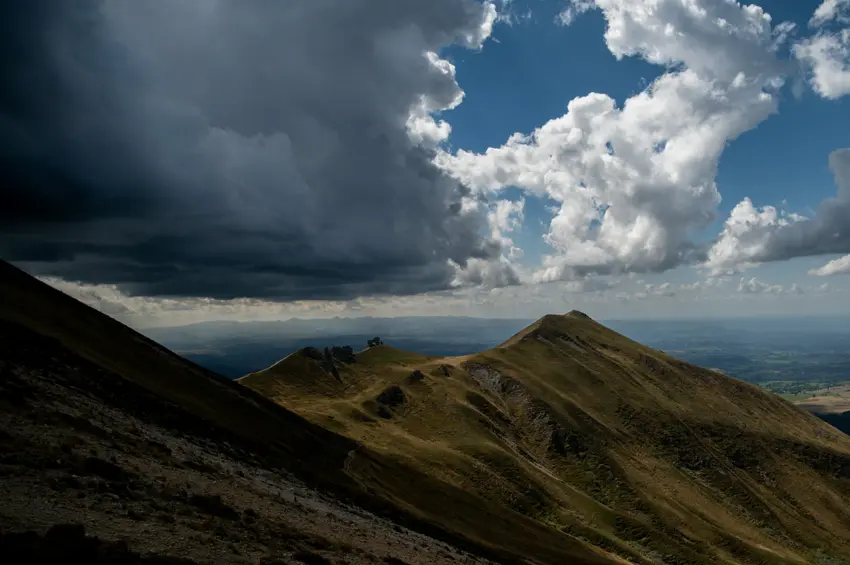
Crossing through around 20 départements, the diagonale du vide (empty diagonal) is a term used by French people to describe a large band of rural areas that are allegedly empty of people, transport services and basic infrastructure.
It's a French version of what Americans call the ‘fly-over’ states - but don't be fooled by the dismissive rhetoric, this strip contains some of the loveliest parts of France.
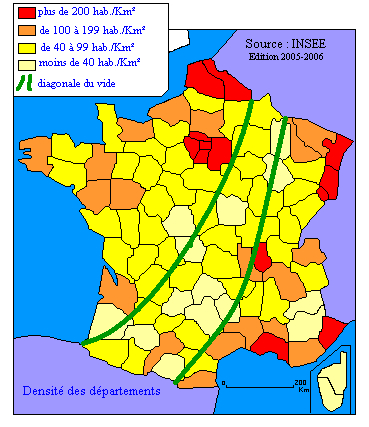
What is the diagonale du vide?
Coined in the 1980s by French geographers, the diagonale du vide is an area roughly ranging from the Ardennes department in the North-East to the Pyrénées mountains in the South-West. The diagonal goes right through the Massif Central, home to Europe’s oldest and largest volcano (now dormant), in the heart of France.
So, is it really empty? The simple answer is of course, no. The name just represents the bit of France with the lowest density of population, caused mainly by a rural exodus that began at the end of the 19th century up until the 1960s.
French students are taught in public schools that the 'empty diagonal' accounts for 42 percent of France but is home to only 6.5 percent of the population.
These days, the term is often used to highlight the inequalities that some rural areas in France face compared to cities, such as lack of public transportation, lack of proper access to healthcare facilities, low tourism, etc.
For example, the Ardèche department does not have a single train station and the département of Creuse does not have any dermatologists.
Not so empty
But as well as being a bit patronising, the term is also criticised for being inaccurate.
“It’s criticised by local stakeholders because it’s stigmatising," said Vincent Béal, professor of political and territorial studies at the Jean Monnet University in Saint Etienne.
"How are they supposed to attract investors and inhabitants if you say there’s nothing? There’s not ‘nothing’ there. You have industries, inhabitants and things happening."
In fact, the diagonal includes major cities such as Toulouse in the south-west or Reims, the capital of the Champagne region in the north east.
Some major French armament industries are located in Bourges, smack bang in the middle of the "empty" diagonal and the global tyre manufacturer, Michelin, is headquartered in Clermont Ferrand - which is itself a thriving and vibrant town.
Throughout the past thirty years, some areas have gradually repopulated, like the Puy-de-Dôme department, which is growing increasingly attractive thanks to beautiful landscapes, access to major cities and affordable housing.
Vincent Béal lives not far from Ambert, a small town in the Puy-de-Dôme department which is close to Clermont Ferrand and Saint Etienne and which recently launched a "€1 home" scheme to attract more people to the area.
He told The Local: “It's a beautiful place in the heart of a regional natural park. It's not too touristy.
"I know quite a few people who settled here recently. Last week, a friend of mine sprained his ankle on a hike and we got him to the hospital in ten minutes."
‘Left behind places’
As experts highlight, the diagonale du vide is nowadays too homogeneous a term to represent such a vast space.
“From a national perspective, it’s true that the diagonal is the least densely populated area of France," said Max Rousseau, a geography and political sciences researcher and professor at the University of Lyon.
"But from a local point of view, things are moving in different directions - some areas are becoming more attractive while others are still declining."
For example, former industrial areas in north eastern France, such as the Ardennes, Meuse or Haute Marne departments, are struggling to attract younger people and are considered to be in decline by experts.
But more than that, the diagonale du vide tends to pit a declining countryside versus booming cities, which is a mistake according to Rousseau.
“It's wrong to say that the countryside is abandoned compared to big cities, which accumulate all the wealth. You'll find derelict areas just as much in the inner suburbs of Paris as in the de-industrialised countryside. Inequalities cut across the urban-rural divide,” he said.
In fact, some rural areas in the diagonal are also home to extreme wealth.
“In the Montagne de Reims, where all the (Champagne) vineyards are, it costs a million euro for a hectare of land,” Rousseau said.
He is currently working on a project called ‘Territoires Délaissés,’ which is based on the notion of ‘left behind places,’ coined by British geographers.
According to Rousseau, this term could adequately describe areas in decline in France without the imposed geography of the ‘empty diagonal'.
Today, you might hear a French person using the diagonale du vide either as a derogatory term against rural départements or as a way to reclaim a cliché and be proud of where they come from.
“The term was biased in the 80s, and it’s even more so today. There is a saying that the ‘empty diagonal is no longer what it never was,’” added Vincent Béal.
But no matter the amount of people living there, the ‘empty diagonal’ has always been the heart of stunning heritage sites, castles hidden in sprawling forests, picturesque villages and their centuries-old churches, as well as wild landscapes.
Comments