
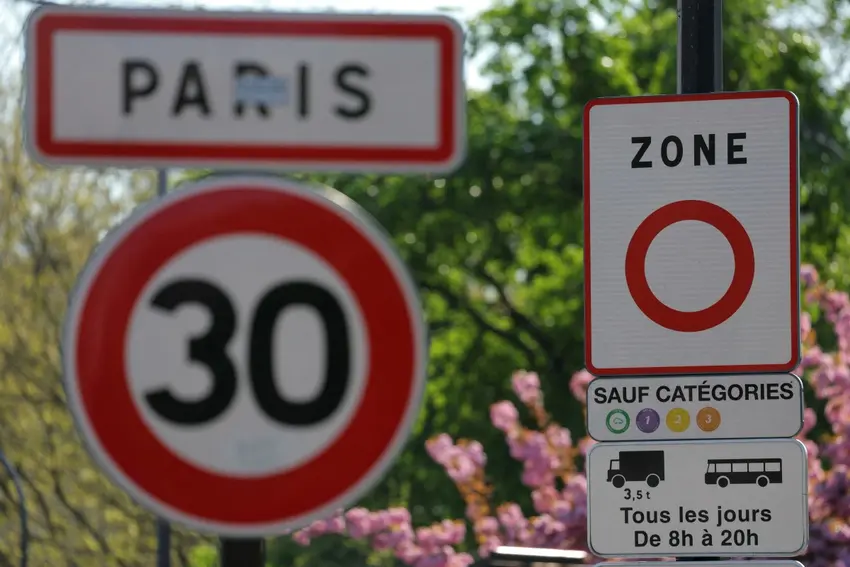
If you're driving in France's biggest towns and cities, your vehicle will need to display a sticker known as Crit'Air, denoting how polluting it is. Some of the oldest and most polluting vehicles under the Crit'Air scheme are banned from city centres, with plans to expand these low-emissions zones.
First introduced in 2017, the low-emissions zones have helped to lower pollution levels in some cities, but they have long been the target of complaints that they are overly complicated and confusing, as well as poorly enforced.
Because many of the rules were introduced on a local level, France ended up with a patchwork of different regulations, meaning the same vehicle might be allowed in the town centre in Bordeaux, but not in Paris. Added to that is the fact that local authorities can implement temporary bans on days when pollution levels are high.
READ MORE: Crit'Air: How France's vehicle emissions stickers work
A new law in 2021 aimed to standardise rules and expand the zones to smaller towns, although wide local disparities remain.
Why are we talking about this now?
On Tuesday, the French Assemblée Nationale passed a bill for the 'simplification' of national rules, which included an amendment that would scrap low-emission zones, or zones à faibles émissions (ZFEs), as defined in the 2021 law.
The goal of ZFEs is to decrease air pollution, which contributes to thousands of deaths in France each year, but critics have said that the ZFEs penalise lower-income workers who rely on their vehicles for daily life and cannot afford to replace them with a newer, more environmentally friendly model.
The move to get rid of ZFEs was primarily supported by members of the right and far-right, as well as some left-wing politicians.
But despite the vote, it is not certain that the low-emission zones will actually be scrapped.
What's next?
Despite the bill passing, there are still several hurdles to clear.
Firstly, the amendment related to ZFEs could also end up being scrapped by France's Constitutional Council (Conseil Constitutionnel). This happens relatively often in the French legislative process - if MPs add an amendment that is completely unrelated to the original idea of the bill, then the Conseil Constitutionnel has the power to deny it.
READ MORE: EXPLAINED: What is France's Constitutional Council and how does it work?
The other concern for French lawmakers has to do with the EU.
The EU promised to give France €40 billion in subsidies as part of its 2020 European recovery plan, with the understanding that France would take steps to reduce greenhouse gas emissions. If France fails to meet these commitments, the country could be required to pay a portion of the aid money back to the EU.
On top of that, France's own Conseil d'État (Council of State) could force the country to pay penalties for failing to meet air quality thresholds if the ZFEs are scrapped, French news site Capital reported.
What is the current status of the low-emission zones?
As of January 2025, there were 42 urban areas classified as ZFEs, meaning motorists must display the Crit'Air sticker, but the requirement to gradually increase bans on polluting vehicles has been diluted quite a bit in the last few years, in response to criticism.
READ MORE: MAP: The French cities with Crit'Air low emission zones in 2025
Initially, as part of France's 'climate and resistance law' from 2021, the parliament voted to gradually require urban areas with more than 150,000 inhabitants to bring in low-emission zones. The idea was that from 2023, Crit'Air 5 vehicles would be banned, then Crit'Air 4 vehicles from 2024 and eventually Crit'Air 3 vehicles from 2025.
However, in reality, local authorities have been allowed to enforce the rules by their own standards, meaning the exceptions from city to city still vary greatly.
Following pushback from the public, the French government announced in 2023 they would soften the plans. They decided instead to create two separate distinctions for urban areas based on pollution levels.
Cities that regularly exceed air quality thresholds (now called ZFE 'Territories') would have to continue to restrict highly polluting vehicles according to the original rules.
In contrast, urban areas that stay within air quality thresholds would be considered 'vigilance zones' and would not be required to enforce new restrictions, though they can do so voluntarily.
At the start of 2025, only a handful of cities opted to tighten restrictions on polluting vehicles, while Paris and Lyon were the only two classed as ZFE 'Territories' and required to restrict Crit'Air 3 vehicles.
So do I still need a Crit'Air sticker?
Fascinating as the French parliamentary process undoubtedly is, for most drivers the big question will be whether you still need a Crit'Air sticker to drive in France (and remember that these are required for foreign-registered vehicles as well).
At present, the answer is yes, they are still required - it will take several months to exhaust the various next parliamentary steps, and then a date for ending the scheme must be formalised.
In truth, Crit'Air is one of the most straightforward pieces of French admin - you order the sticker online (there's even an English-language version of the website) at a cost of €3.18 if you are in France or €4.91 if you are in another country. The sticker lasts as long as you keep the vehicle.
Comments (1)