
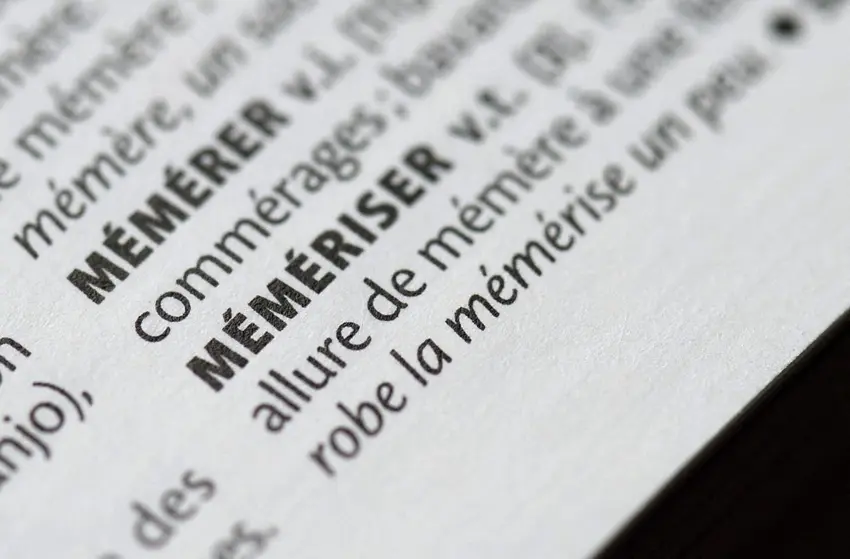
The French dictionary Le Petit Larousse will add 150 new words to its 2026 edition, which will become available to the public on May 21st.
The dictionary's editors told the French press that Le Petit Larousse is meant to "reflect the evolution of the French language", including words that come from different parts of the French-speaking world.
In order to be included, new words must meet two qualifications; they must be 'shared' (in the sense that multiple different groups use the term) and 'widely used'.
Here's a selection of the new words;
Le téléprésentiel
A mix of work-from-home (télétravail) and in-office work (présentiel) - this refers to something that would allow for both remote learning or work, at the same time as the in-person alternative.
For example, the teacher might set up a zoom link to record the in-person class so that people can follow along from home. Or a meeting might be a mixture of in-person attendance with other staff members dialling in remotely. There are several different variations of this.
Le padel
A sport growing in popularity in France, le padel involves four players with rackets who hit a ball over a net in a 20m by 10m enclosed court (allowing for rebounds). The sport combines elements of tennis and squash.
Le food truck
One of several anglicisms that made it into Le Petit Larousse, a food truck refers to a small truck or vehicle that has been converted to include a mobile kitchen. They serve takeaway dishes and have become more common at French markets in recent years.
L'umami
This Japanese word refers to what many chefs consider the fifth fundamental taste (in addition to sweet, sour, salty, and bitter) - it's been commonly used in English for some time, and has now arrived in French too. The flavour has to do with something being savoury, and it's found in dishes high protein (eg meat). It is common in Asian cuisine, with soy sauce seen as 'umami'.
Les feux zombies
Forest fires that may appear to be extinguished on the surface, but in reality continue burning below the ground, even during the winter.
READ MORE: French words and phrases you will only hear in the south-west
Le cécifoot
This sport was one of the highlights of the 2024 Paris Paralympic Games, and now has made it into the dictionary. Cécifoot refers to soccer or football for the blind and visually impaired - in English it's usually just called Blind Football.
Teams can use a guide to help direct players, but otherwise the ball is equipped with a noise-making device so the players can locate it by sound. There are five players per team, including a goalkeeper (who is sighted). In the Paris Games it was staged in the temporary pitches below the Eiffel Tower.
PMR
This acronym stands for personne à mobilité réduite, meaning a person with reduced mobility. This could be a person who uses a wheelchair, but it can also include other groups of people with difficulty moving or getting around eg pregnant women or the elderly.
L'autophobie
The irrational fear of isolation or being alone.
Asexuel (asexuelle)
This adjective refers to a person who does not experience sexual attraction to anyone, regardless of their gender.
Un supercentenaire
A person who is older than 110. In 2022, France counted 39 people who died aged 110 or older, of whom 38 were women. A supercentenaire is not the same as a centenaire (person older than 100). France had, as of 2024, 31,644 centenaires. In English we use super-centenarian, although the term is less common.
La périménopause
The period preceding menopause when women experience irregular menstrual cycles and sometimes the early symptoms of menopause. The term - the same in English - has been widely used in medical circles for years and has its own section on the French public health site Ameli, so it's something of a mystery why it's only now making its way into the dictionary.
Un modèle de langage
This translates as a 'language model' in English, which is a term in artificial intelligence referring to the algorithms used to train AI.
The more usually term for language in French is langue (eg il parle trois langues - he speaks three languages) but in this case langage is used. There is a small distinction between these two words, despite the fact that they are often used interchangeably.
Langage is more broadly defined as any system of communication and is more likely to be used when discussing technology (e.g. Langage de programmation), while langue is the product (the precise sounds and gestures used by a social group to communicate).
READ MORE: Who decides if new French words are masculine or feminine?
Un prompt
This anglicism refers to the instruction that is given to an algorithm or AI model before asking it to generate something, like a text, image or sound. It's common for English language tech terms to be incorporated into French, eg le wifi, un post (on social media) or 'liker' - to like a social media post.
Le tapissage
This does not have to do with carpets (tapis). Instead, it might come up when watching a police show, and apparently has gained popularity thanks to US-based police dramas.
It refers to the police procedure of asking a victim to identify their assailant from behind a one-way glass window. The police officer shows the victim a line-up of several people, and it is up to the victim to identify the person who attacked them. The official French term for this is identification parade.
La micromobilité
The category of methods of transport that are respectful to the environment and help people avoid driving, such as cycling or taking an electric scooter.
Famous people?
The Petit Larousse dictionary also includes 28,000 proper nouns, to help explain the important places and people of the day. In this edition, several iconic French people were added, like the champion Olympic swimmer Léon Marchand, as well as the winning cyclist Pauline Ferrand-Prévot (also known as PFP).
It also included some foreign names, like the American Simone Biles (one of the greatest gymnasts of all time), plus the American film director Wes Anderson.
Comments