

When driving in France, it is important to pay close attention to signage and to respect the speed limit at all times.
Speeding is not only dangerous, it is also punishable by fines, points docked from your driving licence and - in extreme cases - jail time.
You can be pulled over by a police officer for speeding, but you could also be caught by a speed camera and not realise it until you get a fine in the mail.
Pay careful attention to the signs showing the speed limits - it's not uncommon for the limit to change regularly along the same road, especially the rural single lane routes.
The country currently has more than 4,000 speed cameras in operation. You can see a map of where they are located on the Securité Routière website.
Standard speed limit rules
In France, you risk both a fine and points removed from your French licence. Most foreigners in France are required to swap their licence for a French licence one year after moving here (although there are slightly different rules for Brits). You can find details in our separate article.
For non-EU tourists who are driving their own cars in France, whether or not you receive a point on your foreign licence depends on whether your country (or state) has a reciprocal agreement with France.
If you have been snapped by a speed camera while in a hire car, rental companies will relay your information to French authorities, and they may also apply a surcharge for fines.
READ MORE: Can France confiscate your foreign driving licence?
If you are caught going less than 5km/h above the permitted speed, then there is no longer any risk of having points taken from your licence, but you still risk a fine.
If you are caught going more than 50km/h above the limit the situation is a lot more serious, since December 29th 2025 motorists risk jail time, a fine of €3,750 and an entry on their criminal record.
Otherwise, fines are correlated to the 'class of offence'.
If the limit was less or equal to 50km/h the standard fine would be €135, which is the amount for a 4th class offence.
READ MORE: What to do if you get a speeding ticket while driving in France
This fine can either be decreased (minorée) if you pay quickly, or it can be increased (majorée) if you do not pay within the time limit specified in your fine.
The instructions for how to pay will be included with the fine, along with instructions to give details of another driver if you weren't driving at the time.
It's worth noting that any attempt to 'detect or disturb' a speed camera is an offence with a 5th class fine - €1,500
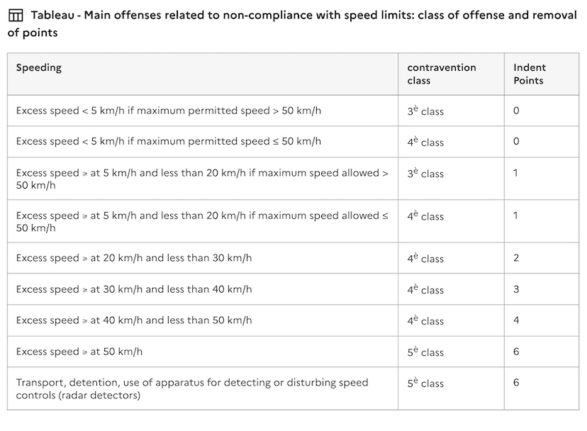
You can also have points taken from your driving licence, as outlined in the above table - in France, drivers with a full licence start with 12 points, points are taken off for traffic offences such as speeding or running a stop sign and if you get to zero your licence will be taken away.
What is the 'margin of error'?
In theory, any speeding can lead to a fine, but if you are caught by a speed camera then there is a 'margin of error' to consider too. Keep an eye out for signage indicating that you have entered a zone with radar enforcement.
Fixed speed camera (radar de vitesse fixe) - This would be a box-looking radar device along the side of the road that is permanently placed there. It has a margin of error of 5km/h under 100km/h. Over 100km/h, a five percent margin is applied.
Basically, this means if the fine says you were driving at 78km/h in a 70km/h zone, then you subtract the margin of error to get the vitesse retenue.
In this example, 78 - 5 = 73. Regardless of the margin of error, you were still speeding three kilometres above the limit, and thus you will get a fine but no points on your licence.
Mobile Speed Cameras (les radars mobiles) - These are the speed cameras installed in police vehicles, and they are less accurate. The margin of error is 10km/h for speeds below 100km/h, and it is 10 percent for speeds above 100km/h.
Stopped radar cars (radars vitesse embarqués) - These are speed cameras positioned inside or outside of vehicles along the roadside. The margin of error is also 5km/h under 100km/h, and five percent above 100km/h.
You might not see a 'flash'
Several speed camera models do not 'flash' anymore. In fact, since 2019, France has deployed over 400 units of the latest 'Fusion 2 Mesta turret radar' (the latest 'fixed radar' on the side of the road).
This camera uses an invisible infrared flash, so you may not know that it caught you speeding.
According to Le Figaro, France plans on deploying more of these units across the country, and eventually they will represent 75 percent of speed cameras on the roads.
Vocab guide
Exces de vitesse - speeding
Maximum vitesse - speed limit
Vitesse retenue - Your recorded speed minus the margin of error. This is the speed used to calculate your fine if you were caught by a radar device.
Appareil de contrôle - The type of speed camera or device that registered you as speeding
Amende minorée - Fine at the decreased level. This applies if you pay quickly. Usually the limit is 46 days, from the date the ticket was issued.
Amende forfetaire - The standard fine. This is the amount you pay if you do so within the 'standard' period (meaning 47-76 days).
Amende majorée - The increased fine for late payment. This is the amount you would pay after 76 days.
Avis de contravention - Ticket/ notice of violation
Formulaire de requête en exonération - Request to contest the ticket. This form will come with the ticket in the mail. You can fill it out and send it back to contest the charge and request a reimbursement. Keep in mind that unless someone else was driving your vehicle, or it was sold/ destroyed/ stolen, then you must pay the ticket and request reimbursement.
Comments (1)