
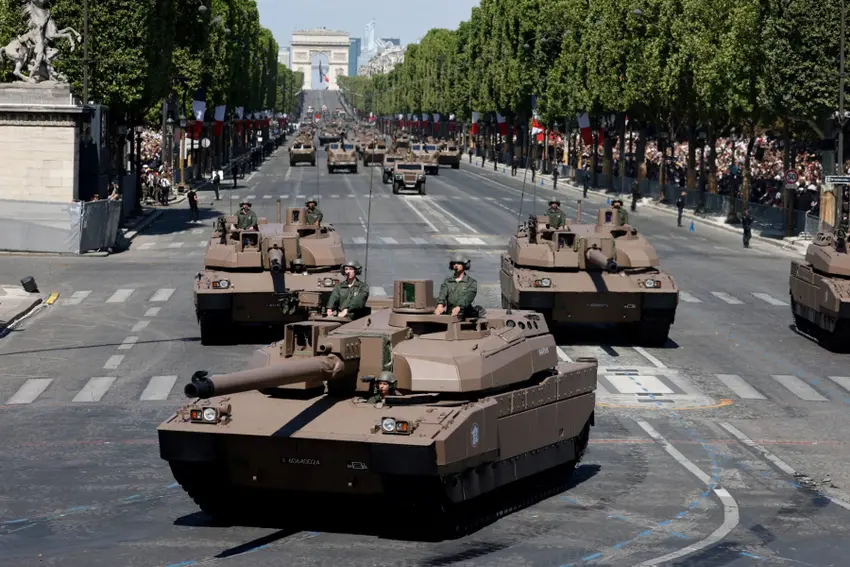
France and Britain are so far the only countries to step forward publicly to offer troops for a peace-keeping force in Ukraine. They envisage a “reassurance” force of 30,000 troops. President Volodymyr Zelensky says that it needs ten times that number to dissuade Russia from pursuing the Ukraine war up to, and beyond, the frontiers of Nato.
France and Britain are two of the three biggest military powers in Europe. Why not offer more troops or tanks and planes? They don’t exist. Twenty years ago, France had 800 large battle tanks. It now has 222. France can mobilise at most 77,000 front-line troops. The UK has even less.
Overall, democratic Europe is far richer than Russia and has more troops and tanks and planes but, without US help, it has enormous gaps in missiles, ammunition, shells and satellite surveillance.
EU leaders meet this Thursday to discuss ways of mobilising hundreds of billions of euros to build a credible European force to deter Russia. How long will that take? Maybe, a decade, says President Emmanuel Macron.
We are all responsible for the mess we find ourselves in. Politicians and voters of all parties and all countries in western Europe have conspired to believe that a threat from the east no longer existed and that, if it did, the United States, the arsenal of democracy, would come to our rescue.
The first illusion vanished with Russia’s invasion of Ukraine in 2022 (and should maybe have vanished when Vladimir Putin invaded Crimea in 2014). The second illusion died last Friday when the US President and Vice President gabbled Russian propaganda lines while attacking President Zelensky on live TV in the Oval Office.
One European country and one European statesman have, in theory, challenged the complacency and short-sightedness of the last decade. France has long argued that the European Union should have a powerful, independent defence capability, within Nato or outside it. President Emmanuel Macron has been warning for eight years that Europe needed to build “military and strategic autonomy”.
And yet France, the most capable military nation in western Europe, is just as unprepared as other EU nations for the kind of threat that we now face.
Macron, to his credit, has been modestly rebuilding the French military since he came to power in 2017. By the end of this year, France will meet the Nato target, set in 2006, of spending 2 percent of GDP on defence.
Nonetheless, according to defence analysts, the French military is unable to fight the kind of grinding, conventional land and air war which Russia has waged in Ukraine in the last three years. Although better equipped than they were in 2017, the French army and air-force are configured to fight only short, smart, tactical battles.
France has far fewer warplanes and tanks than it had at the start of the century and poor stocks of rockets, artillery shells and small ammunition. According to one assessment, the French air force - 250 warplanes, compared to 374 two decades ago – has the capacity to fight intensively for no more than a couple of weeks. Its Mirages and Rafales are among the most advanced fighting aircraft in the world but they do not have the numbers or ammunition to sustain a long, full-frontal air-war.
The same is true of France’s Leclerc tanks and state-of-the-art Caesar mobile field guns. They are excellent but not numerous enough to fight a long, grinding campaign. The Leclerc design is 40 years old; production ceased in 2006 - it would take over a year to start to make them again.
The French military historian and analyst Michel Goya wrote: “We have not only less equipment than we did (in the 1990s) but its true availability is much less: too old for some things, too sophisticated for others… let alone the lack of munitions to fight for more than a few weeks.”
Michael Shurkin, an American expert on the French military, says that the problem is that France – like the UK and other European countries - has planned for short, tactically smart campaigns. It now faces the prospect of mass siege or set-piece warfare of a kind that seemed to belong to the past.
French military planning was based partly on the belief that the US would, if needed, fight for Europe’s freedom. It was also based on the notion that France’s independent nuclear deterrent - and America’s and Britain’s - made a full-scale invasion of Nato unthinkable.
Now both doctrines are shaken. In the Trump era, would the US start a nuclear war if Russia invades Estonia or Poland? If not, would France risk the destruction of Paris by threatening to use its “force de frappe” to deter an invasion of Lithuania or Romania?
President Macron has invited other EU countries to join France in considering that question. There is no obvious, credible answer.
The EU summit this week may set the machinery in motion to build a powerful European military force. But it will take a decade, according to Macron, to recruit and train the troops, create the industrial base and design and build the equipment. Do we have a decade?
Russia has taken a beating in the Ukraine war. If there is a ceasefire, Putin or a Putin-successor may not be ready to provoke and invade again for who knows how many months or years.
In that period, France, Britain and the rest of democratic Europe will be vulnerable to constant provocation and threats. Russia might be tempted to start a war before the Europeans could re-arm (the kind of calculation which produced two world wars in the last century).
Hence Europe’s existential dilemma. It needs the US to remain engaged in Europe in the short-term, but at least part of the Trump administration seems to want to engage on the Russian side.
Hence also many of the contortions of French decision-making in recent weeks and months.
Why has France not given more military equipment to Ukraine? It did not have more to give.
Why is Emmanuel Macron, who preaches European military autonomy, begging for US security guarantees for any truce in Ukraine? Because Europe cannot yet provide those guarantees alone. In terms of air power and satellite intelligence, France and other EU countries are dependent on the United States.
That also explains why Macron and Starmer and some others have been muted in their public outrage at the Oval Office ambush of Zelensky. It explains the difficult and humiliating message which Macron, Keir Starmer and other European leaders have been forced to offer to the egomaniac in the White House.
Yes, we are prepared to stand alone for democracy if you betray us. But not yet.
Comments (2)