
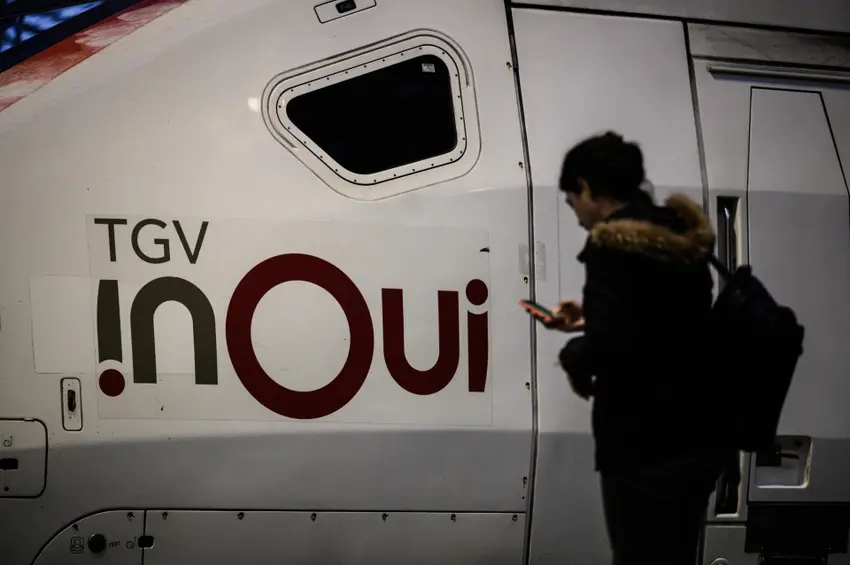
This week a French train passenger known only as David made worldwide headlines after he was fined €150 for using his phone on speaker mode in Nantes train station.
It's fair to say that most people did not sympathise with David - reactions to the story mostly went along the lines of 'good, serves him right, people using their phone on speaker in public places are a blight upon society'.
But while David says he intends to instruct a lawyer to contest his fine - which has now been raised to €200 because he refused the option to pay immediately - we take a look at the rules on phone use on French trains.
The basic principle when travelling on France's SNCF train network is that you should avoid doing anything to unreasonably disturb your fellow passengers.
SNCF itself does not specify phone usage within its list of onboard rules, but Article R2241-18 of the French Transport Code states "it is forbidden for any person to use, without authorisation, sound devices or instruments, or to disturb the peace of others by noise or disturbances” in “spaces and vehicles assigned to the public transport of passengers or goods”.
It's this Code that allows SNCF staff to fine people who are disturbing the peace of their fellow passengers - although you will usually get a warning first which is only upgraded to a fine if you ignore it.
There are also regular announcements on French trains that cover the use of phones on board.
Alerts - passengers are asked to switch their phone to either silent or vibrate mode in order to avoid an endless series of beeps or sound alerts when messages arrive or calls come through.
Making a call - if you wish to make or receive a call while on a train you should go to the vestibule (the area between carriages) or the bar or buffet car, if the train has one. This applies to all types of call - either on speaker, in the normal mode or with headphones.
Headphones - if you want to use your phone to watch a film, view video clips on social media, listen to music or a podcast you are expected to use headphones. Doing any of the above activities without headphones definitely counts as disturbing your fellow passengers.
Speaker mode - just don't.
The above rules mean that you will notice that French trains tend to be quite quiet, especially the long-distance TGV routes, so if you're with a group of friends it's a good idea to try and modulate your voices and keep your chat at a low volume.
Tickets - it's increasingly common for people to use digital train tickets stored on their phone, either in the SNCF Connect app or downloaded from an email. If you choose to use this style of ticket it's up to you to make sure your phone is charged - if your phone is dead when the ticket inspector comes round, you will be fined for not being able to show a valid ticket. That said, you can get this overturned afterwards (by showing proof of your valid ticket). Most French trains have charging points on board, usually below the seats, though budget and regional trains sometimes do not.
Wifi - some French trains, usually the high-speed TGV routes, have onboard wifi. Reliability and connection speeds vary.
Train stations - the above rules all apply when you are on board the trains. David's case was slightly unusual in that he was fined for using his phone in the station.
There are usually no restrictions on phone usage within a station, which tend to be quite noisy places anyway, although SNCF's version of events is that David was actually in a waiting room, and his loud phone conversation with his sister was disturbing those around him.
In general it's better to follow instructions given by SNCF staff or by the French railway police, the Sûreté Ferroviaire. Both have the power to issue fines while the railway police have the power of arrest and also carry guns.
Comments (1)