
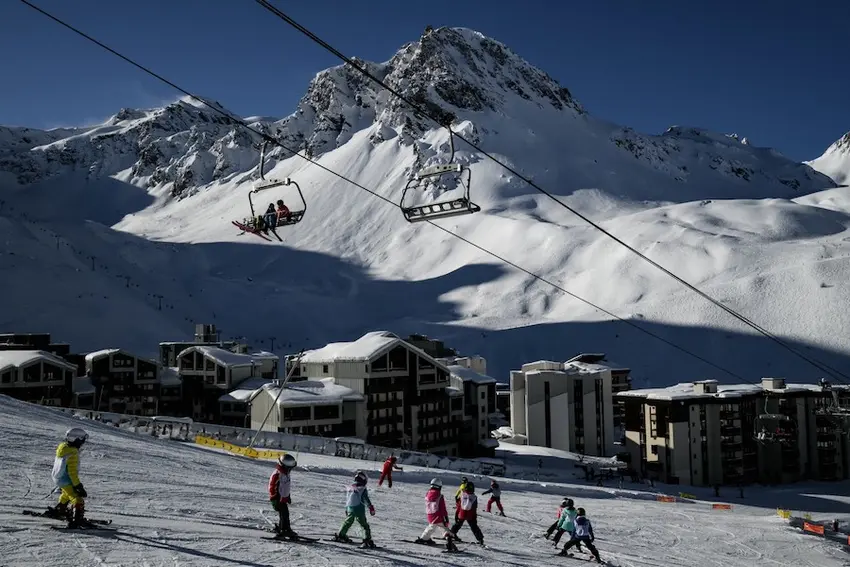
France is a popular place for skiers and its peak season is around the February school holidays.
Each year French ski resorts see over 10 million visitors, generating over a billion euros in revenue and accounting for an estimated 120,000 direct jobs in France.
At least a quarter of tourists are foreign, Le Monde reported, and they are mainly from the UK and nearby countries, such as Luxembourg, Belgium and the Netherlands.
So if you are one of those planning to travel to the Alps this February - whether you're travelling from France or arriving from overseas - here's what you need to know;
Road closure
If you are heading to the Savoie area this year, be aware that there has been some travel disruption in recent days.
At the start of February, there was a landslide and three huge rocks fell off a click onto the RN90, near Aigueblanche.
This road is crucial for people trying to get to resorts near the Tarentaise valley, such as 3 Vallées, Tignes, Val d'Isère, La Plagne, and La Rosière (ski area of San Bernardo). Smaller resorts like Sainte-Foy Tarentaise and Pralognan-la-Vanoise are also affected.
You can find the latest on the likely reopening date HERE.
French national rail service SNCF has promised to add an additional daily TGV train to and from the area - specifically from Paris to the Bourg-Saint-Maurice station - during the school holidays, which would mean 1,000 extra seats will be available per day. More information in our separate article.
When will resorts be most crowded?
The biggest crowds are usually during the February school holidays. In France, the winter holidays are staggered, in a way that is specifically meant to benefit the ski industry, with the two-week holidays starting on February 7th for Zone B, February 14th for Zone C and Corsica and February 21st for Zone A.
Meanwhile schools in the UK mostly have half term from February 14th.
Will there be snow?
As of early February, heavy precipitation and storms brought significant amounts of snow to the Alps.
According to La Chaine Météo at the start of February, "snow conditions in the Northern Alps are good at medium and high altitudes (1,500m), with plenty of snow to enjoy."
As for the southern Alps, the forecasters noted that snow levels at 1,500m were 'average'.
If you have a trip booked, you can check in advance the snow level at your resort's website or by looking it up on Météo France.
Ski resorts routinely update their websites with the latest snow reports - and many include webcams that show current weather conditions. It’s a good idea to check those out to decide whether you need your skis or your hiking boots before you head off on holiday.
Due to the climate crisis, ensuring that there will be snow on the mountain has increasingly become a question of altitude. Resorts below 2,000m are more of a gamble, while those at higher altitude are more likely to be able to guarantee snow.
As of 2024, 35 percent of French ski slopes were equipped with snow cannons (for artificial snow). Nevertheless, 180 ski areas have closed since the 1980s, primarily smaller sized resorts at lower altitudes.
There have also been several avalanche warnings put in place in recent days, particularly in the southern Alps. In France, avalanche risk is ranked on a scale of one (little to no risk) to five (high risk).
How safe is skiing in France? Should I be worried about avalanches?
During the last week of January, avalanches in the French Alps killed four Norwegian skiers, who were swept away by the off-piste torrent of snow and ice in the southeastern Savoie region.
On the same day a separate avalanche near Chamonix in the Haute-Savoie region to the north killed a Swiss skier, according to the public prosecutor's office in nearby Bonneville. Meanwhile, earlier in the week a 55-year-old British man was killed in a kilometre-long avalanche while skiing off piste in the Grands Montets ski area near Chamonix, according to UK media reports.
However avalanches rarely affect people skiing in on-piste areas. They mainly concern ski touring and off-piste skiing outside of marked, secure ski areas (which are usually clear based on ropes or signs).
If you plan to ski off piste, pay very close attention to avalanche risk levels for that day and consider carrying a Détecteur de victime d'avalanche (DVA) device, which helps rescue workers find you if you are trapped under the snow.
As for general safety, the National Mountain Safety Observation System found that there has been an increase in downhill skiing accidents over the last two years, but no increase in the number of fatal accidents.
It found that in the 2023-2024 season, 152 downhill ski accidents were reported, in comparison to 142 in 2020-2021 and 110 in 2017-2018, French daily Midi Libre reported.
READ MORE: Is skiing in France becoming more dangerous?
What if I want to cancel my trip?
You may be able to cancel your trip and receive a refund, but it depends on why you are doing so and whether you are subscribed to a travel insurance plan.
Classic cancellation policies usually relate to illness, death or accidents. If you wish to cancel your trip because of the RN90 landslide, then it's unlikely that you will receive any payout as the resorts remain accessible (despite heavy traffic), according to Franceinfo.
If you want to cancel your trip due to a lack of of snow, in most cases the answer will be no, though you should check your travel insurance policy.
Some specialist travel insurance policies have 'piste closure coverage' that kicks in if the piste in your resort is closed for any reason - too little snow, avalanche risk, etc. However this is a small daily payment (usually between €10 and €50 a day) that is intended to cover the cost of travelling to a neighbouring resort to ski or snowboard.
Some policies will also refund specific things like the cost of ski passes or ski lessons if slopes are closed. If possible, you might consider simply waiting to book daily ski passes until arrival.
Virtually no policies cover the cost of cancelling that holiday altogether - including flights or accommodation - due to a lack of snow.
How much should I expect to pay?
Ski trips can be very expensive, especially if you have to rent equipment, costing hundreds of euro at minimum per person.
According to the website ski data, daily ski passes in 2024 in France range from €31 on the low end to €64 on the upper end, for more expensive resorts like Val Thorens or Meribel.
READ MORE: From high altitude to family friendly: 15 of the best French ski resorts
Renting an apartment with space for two to six people in the northern Alps would require a budget of at least €1,000, and that climbs up to €2,000 if you want a chalet with space for six to 10 people, according to French daily Le Progrès (citing data from 2021).
Comments