

On Friday, the mayor of Nice issued a ban on large cruise ships - those carrying more than 900 passengers or more than 190m long - joining a growing list of French cities imposing limits on cruise ships.
Announcing the ban which comes into effect in July 2025, mayor Christian Estrosi noted concerns about environmental factors and over-tourism, saying that the city in 2024 had 160,000 cruise tourists come ashore, and by 2026, that would rise to 300,000.
He added that smaller ships would still be welcome, saying: "Pleasure boating, yes, floating buildings, no."
With over 5,500km of coastline, France is a popular destination for cruise ships (paquebots or bateaux de croisière in French), but there are increasing concerns about this method of tourism.
The French government tourism agency, Atout France, estimated that mainland France saw more than 3.8 million cruise passengers pass through in 2023, an increase of 13 percent compared to 2019 (pre-Covid). They found that most passengers were German, American or British.
The vast majority of passengers (three million) went to Mediterranean ports. The other 704,500 went to the Atlantic coast, which has been growing in popularity in recent years - more than doubling since 2014.
France's overseas territories - especially the Caribbean islands of Gaudeloupe and Martinique - also see a lot of cruise tourists, but the above data refers only to mainland France, aka l'hexagone.
Which cities get the most cruise traffic?
Marseille stands out amongst French cities. In its 2023 report, the city noted 626 stopovers, with over 2.5 million cruise tourists in total.
It is followed by Ajaccio in Corsica, Cannes, Nice and Villefranche-sur-Mer (which is just outside of Nice), according to a French government report.
Smaller ports along the French riviera are also hot-spots, such as St Tropez, Menton, and La Ciotat.
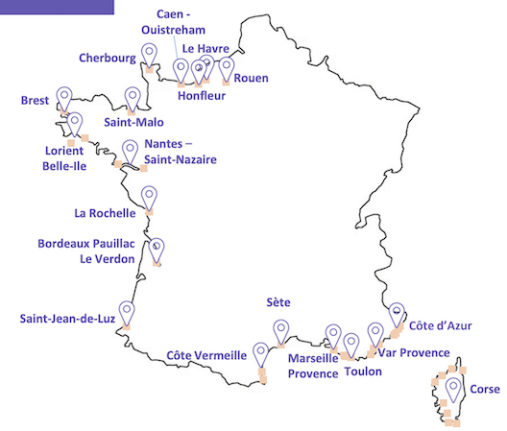
As mentioned above, the Atlantic coast is less of a cruise destination than the French Riviera, but cruise companies have increased efforts to target south-western France, with a growing number of cruises headed for Bordeaux and La Rochelle.
In 2023 Bordeaux reportedly welcomed 60 cruise ships, compared with 43 in 2019.
Meanwhile, Brittany and Normandy in north-western France also are home to several cruise ports, from La Havre to smaller locations like Douarnenez in Finistère. Cross-Channel traffic is not included in cruise figures.
The global cruise ship industry expects numbers to keep rising, with estimates that they will see 10.7 percent more passengers in 2028 than in 2023.
How much money do they bring into France?
Overall, research is mixed as to the true impact cruise ships have on local economies, in contrast to typical land tourism. Critics point to the money that local governments spend to accommodate ships, as well as the fact that many available statistics about local economic impact are produced by cruise companies themselves.
Cruise ships often follow an 'all-inclusive' model, offering passengers everything they need on board, from bars and restaurants to activities - and therefore reducing the incentive to spend in local bars, cafés and restaurants.
A 2024 study found that factors like length of the visit to the city (from just a few hours to overnight stays), as well as its tourism offerings and the age of passengers, play a role in whether or not passengers will disembark and spend money in the local economy.
In France, the spending depends on the city.
A study by geographer Victor Piganiol, showed that a cruise passenger "spends an average of €150 a day and up to €200 during a stopover" in Bordeaux, compared with an average of €89 in Le Havre and €80 in La Rochelle. This higher spending in Bordeaux is mostly explained by people purchasing wine.
"When they pass through Bordeaux, the cruise promotional brochures highlight the vineyards and their prestigious appellations", the researcher told AFP. Visits to nearby châteaux are often organised and included in the cruise package.
In Marseille, a separate study found that people who spent at least five hours in the city spent on average €57 for the day - compared to €132 per day for non-cruise passengers.
It also found that people who either started or ended their cruise journey in Marseille would spend €78 per day per person, with almost a third opting to spend a night in town before or after the cruise. In this case, they spent €171 a person, L'Echo Touristique reported.
In 2022, the Cruise Lines International Association (CLIA) estimated that cruise ships had a €3.5 billion "total GDP impact" on France, which included things like ship and capacity building, cruise line purchases, passenger spending and crew spending.
CLIA estimated that "cruise line employment (crew and head office employees) equated to 1,245 direct jobs, as well as 36,730 jobs created through direct and indirect effects.
Local response to cruises
Despite some evidence that cruise ships can stimulate local economies, many residents across French port towns have complained of over-tourism and negative environmental impacts from cruise ships.
Most recently, members of the environmental groups 'Stop croisières' and Extinction Rebellion in inflatable kayaks sought to block cruise ships from entering Marseille's port.
In 2022, over 44,000 people in Marseille signed a petition against pollution caused by cruise liners, and in March 2023, residents' associations in Marseille lodged a legal complaint over ocean traffic pollution in the port area, which regularly exceeded European Union limits.
Meanwhile, in 2023 the small port-town of Douarnenez in western France made international news when local residents banged on saucepans and chanted 'go home' to passengers of the 'World Traveller' cruise ship.
La Rochelle is planning to only allow 27 ships to stop over in 2025 - in contrast to 31 in 2024 and 37 in 2022 - and set a goal to halve emissions from cruise ships.
Meanwhile, in Bordeaux, the city council in August proposed that cruise ships no longer moor in the city centre, and instead move further along the right bank of the Garonne, in hopes of addressing aesthetic and environmental concerns.
The mayor Pierre Hurmic, from the Green Party told AFP: "More and more people in Bordeaux are being disturbed by the arrival of cruise ships in the city centre, and it's becoming increasingly unpleasant, adding that they resemble "actual floating buildings in some of the most aesthetically pleasing parts of the city".
Environmental impact
Cruise liners are known to be huge polluters - a 2019 study by the NGO Transport & Environment found that cruise ships were responsible for more pollution than all of Europe's automobiles combined.
As for the port of Marseille, France's top cruise stopover, it is one of the most polluted in Europe, according to a recent study.
This picture will hopefully improve after May 2025, when Mediterranean-wide rules will from the International Maritime Organisation (IMO) will require that cruise ships cut sulphur oxide emissions by 80 percent. It is estimated this will lead to an annual reduction of 8.5 million tons of emissions into the atmosphere, and protect marine life.
Comments (2)