
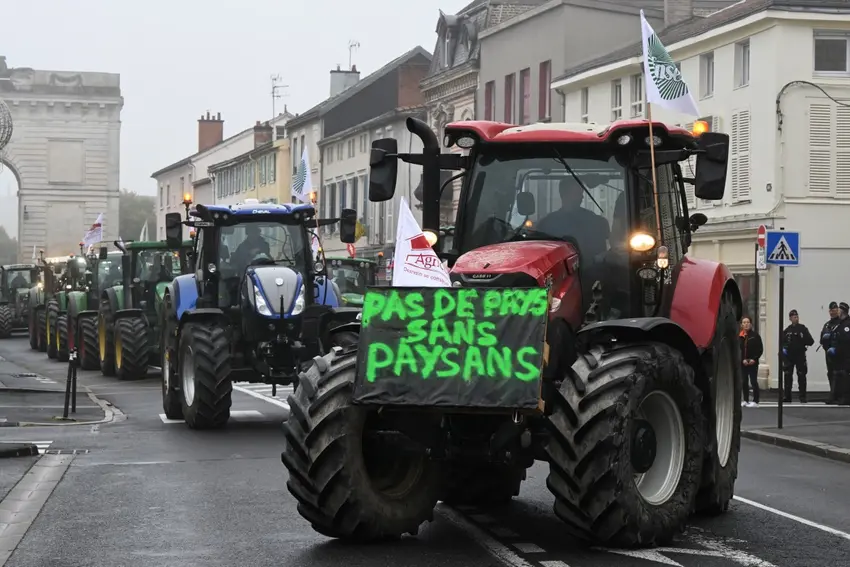
Fresh farmers' protests are expected to begin this week in France, less than a year after widespread action from farmers managed to bring swathes of the country to a standstill with roadblocks and go-slow tractor convoys.
When will the protests start?
Farming union the Fédération Nationale des Syndicats d’Exploitants Agricoles (FNSEA) has called for protests lasting several days ‘in every département of France" from Monday, November 18th “to make France’s voice heard at the G20 summit in Brazil” the union’s president Arnaud Rousseau has said.
Meanwhile, other farmers' unions, such as Confédération Paysanne and Confédération Rurale, also announced plans for demonstrations this week and next week.
Confédération Paysanne will host a rally in front of the French finance ministry at noon on Wednesday, while the anti-EU, right-wing Coordination Rurale, called for "an agricultural revolt, with a food and freight blockade" starting on Tuesday, November 19th.
Some smaller demonstrations have already begun, including a rally in front of the préfecture in Tulle (Corrèze) last Thursday, and at the Deux-Sevres préfecture at the start of the month.
In terms of how long they will go on - this is still unclear at the moment, but earlier in the year they lasted several weeks.
What will protests entail?
Rousseau insisted that unlike previous protests this year farmers would not seek to disrupt daily life: “The first message we want to get across to the French is that we're not here to annoy them – we are not targeting the motorways.”
The protests in February and March involved rolling roadblocks (opérations escargots) and blockades led to over 70 of the country's autoroutes being either fully or partially blocked.
There were also blockades and traffic jams along the ringroads of French cities, as well as demonstrations in front of préfecture buildings across the country.
If farmers' protests do end up escalating to road blockades, people should primarily expect traffic delays. Public transport in France's cities would likely not be affected.
You may also notice that signs in rural France are turned upside down - this was an early symbol of farmers' discontent at the start of the year, and many of the signs have remained flipped over.
You can keep up with The Local's coverage in our 'Protests' section.
Why are farmers protesting?
The protests in February and March were eventually called off after the government gave assurances, but unions say that some of their demands have still not been met.
On top of that, farmers were hit hard by poor wheat harvests this year, as well as a series of health crises in livestock farming, while concerns remain about high prices and low salaries.
More recently, there have new worries about the possible impact that eventual US and Chinese tariffs could have on France.
However, the headline grievance is focused on EU policy, and the dates of the planned demonstrations coincide with Brazil hosting the G20 conference.
Farmers see this as a moment to put pressure on France and the EU against certain trade policies they consider to be threatening, such as the 'Mercosur' free trade agreement, with several countries in South America, such as Argentina, Brazil, Uruguay, Paraguay and Bolivia.
This agreement would force French farmers to have to compete with south American products, such as beef, sold on the European market.
Cyril Bousquet, a cattle breeder in Tarn, told the French press "We'll never have the competitive clout of those big countries that deforest, who also use GMOs and pesticides that are banned here. We need standards and barriers to ensure that we can compete in the same markets."
French agricultural unions have said that signing the Mercosur treaty would be a 'red line' that should not be crossed, and that they would not rule out bringing mobilisations to Brussels if need be.
How has the French government responded?
"I hear and understand this anger and concern," France's agriculture minister, Annie Genevard, told TF1 on Tuesday morning.
"It takes time for the measures to trickle down to the ground, but they are in the budget. I have honoured the commitments that had been made by the government and I have taken other measures because the crisis has intensified in certain territories," she said.
Genevard also mentioned having introduced a 'single administrative inspection' (meant to 'limit the pressure of on-site inspections to one visit per year, per farm').
The minister of agriculture also claimed that the Mercosur agreement would not be signed at the upcoming G20 conference, to be held in Rio de Janeiro on November 18th and 19th.
Genevard said on Sunday on France 3, the television channel, that the President of the European Commission was "fully aware of France's position on Mercosur" and that "France is not alone in this refusal".
Comments