
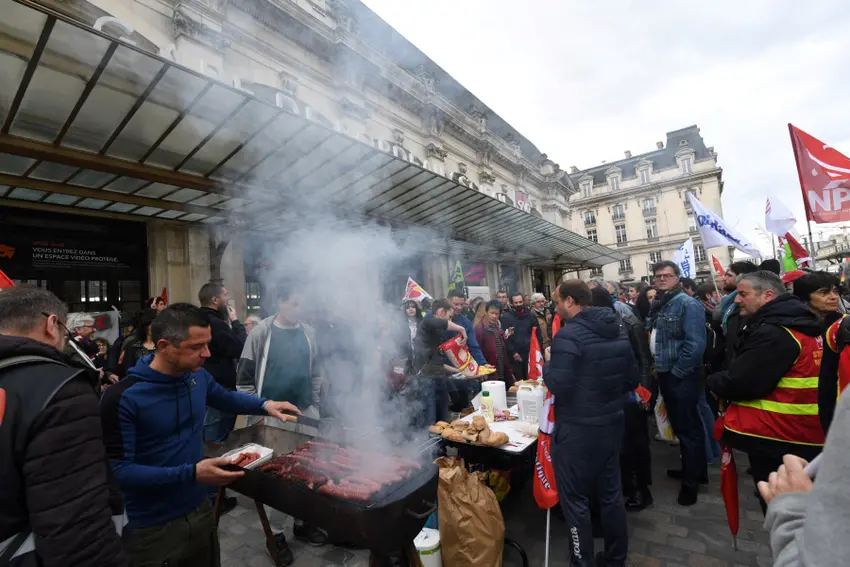
The main unions representing French rail workers have called for strike action on Thursday, November 21st. A full strike timetable will be published nearer the time, but the fact that the unions are working together suggests that disruption will be significant.
But the statement from the joint union group also said that they would be prepared to push for "un mouvement de grève plus long et plus fort en décembre" (longer and stronger strike action in December - a peak travel time on French railways) if SNCF and the government does not address their grievances.
What do unions say?
This strike has been called for a specific reason - the changes to the company’s freight transport subsidiary Fret SNCF, but in their press release the unions also denounced “the privatisation of TER, Transilien and Intercités activities” - that’s referring to the local train network TER, Paris regional trains Transilien and Intercité, which are the long distance routes which aren’t part of the high-speed TGV network.
They also denounced “the break-up of SNCF Réseau” as a result of the opening up to competition and one union called the action “act two of the movement against the 2018 reforms”.
Finally, the unions said their action was also against the "illegitimate government" of France - a reference to the cobbled-together coalition headed by right-winger Michel Barnier following the inconclusive result of the July parliamentary elections.
Is SNCF state owned?
SNCF has been state owned since it was first created in 1938, when the Société nationale des chemins de fer français was created by merging five private rail companies to create a national rail network.
At that point it had 515,000 employees, today - due mostly to technical changes on the railways - it has around half that number, 278,000 employees.
It’s a popular company with more than half of French people viewing it in a "positive light" according to polling, while passenger numbers are showing a steady increase. In 2023 a record 122 million passengers used the network, a 4 percent year-on-year increase.
In recent years the company has been operating in profit, although it does have a heavy burden of historic debt - around €55 billion - that makes its overall financial position less secure.
So what is the privatisation?
Unions reference "la privatisation dans les activités TER, Transilien and Intercités" - but it's probably not privatisation as English-speakers would think of it - where a private company runs rail services for profit (or not) and the government is not involved.
Instead they are referring to the opening up of the French rail network to competition.
Since 1938 SNCF wasn't only the national rail company, it was a monopoly. However since 2019 some parts of the network are opening up to competition. This is part of an EU-wide opening up of state rail markets, designed to improve the network and get more people travelling by train, which is much better for the environment than going by car or by plane.
On a gradual basis France's domestic and international freight services, followed by passenger lines on the local TER and Transilien services and then the Intercité routes were opened up to competition, whereby an external company can bid against SNCF to run a certain route or collection of routes.
For local TER services bids are decided by regional authorities and six of France's 13 regions have opened up bids for services; Provence-Alpes-Côte d’Azur, Hauts-de-France, Grand Est, Pays-de-la-Loire, Burgundy-Franche-Comté and Normandy.
In the Paris region bids are decided on a line-by-line basis, and so far SNCF has been the successful bidder.
External companies can also apply to run inter-city lines - for example Spain’s state-owned Renfe rail company now runs some services on the Paris-Marseille line, while Italy’s partially state owned Trenitalia runs some Paris-Lyon services.
These are likely to expand because since December 2023, local and national governments have been required to open up lines to bids, within strictly defined terms of services, within a 10-year period.
The government says this will offer more choice to passengers and potentially cheaper tickets, while rail unions fear it will lead to a gradual splintering of the service with private companies cherry picking the profitable lines and ignoring the less profitable local lines.
What's this 'act two of 2018' about?
Initially SNCF was a straightforward, single, state-owned company but in 2018 it was reorganised into five public limited companies - albeit still 100 percent state owned.
There’s now parent company SNCF SA and four subsidiaries; SNCF Réseau, SNCF Voyageurs, Rail Logistics Europe and SNCF Gares & Connexions.
SNCF also mostly owns Geodis, which operates most rail freight services in France, Keolis which operates some city public transport and also international lines and services outside France. Plus it is a majority stake in the Eurostar.
The 2018 reorganisation - coupled with changes to the pension regimes for rail workers - provoked months of strikes. In that case the strikes were intermittent, with single strikes every couple of weeks, but they still caused severe and long-lasting disruption.
Unions have not said whether they intend to copy this tactic, only that they see the new strike actions as a continuation of this battle.
Comments