
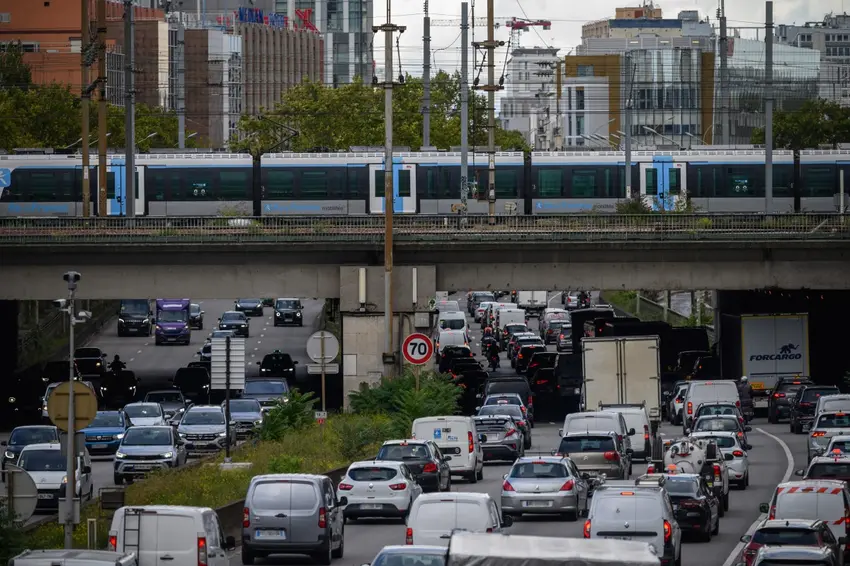
Starting on January 1st, 2025 - vehicles with Crit’Air 3 stickers (meaning diesel cars from before 2011 and petrol/gasoline before 2006) will encounter new restrictions when driving in the Paris area.
The Crit'Air 3 vehicles will no longer be able to drive within the Greater Paris area's 'low emission mobility zone (zone à faibles émissions mobilité – usually known by the initialisation ZFE-m) between 8am and 8pm, Monday to Friday.
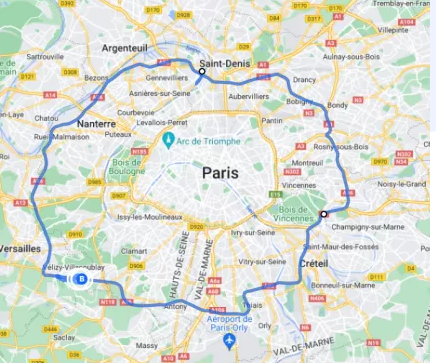
The ban will cover the area within the A86 autoroute - this comprises the whole of the city of Paris, plus most of its inner suburbs.
READ ALSO Crit’Air: How France's vehicle emissions stickers work
The enhanced restrictions affect petrol-engine vehicles registered before 2006, and diesel vehicles registered between 2006 and 2011. Vehicles older than that are already banned under the first phases of the Crit'Air rules.
The restrictions on Crit'Air 3 vehicles were initially due to take effect in 2022, but have been repeatedly pushed back.
Further delays are, however, impossible, as the Loi Climat et Résilience has set a binding deadline on the Métropole du Grand Paris to impose the restrictions, 'since the metropolitan area still regularly exceeds regulatory air quality thresholds'.
How many vehicles will be affected?
According to a recent report by the Atelier parisien d’urbanisme (APUR), this third stage of restrictions will have a much greater impact than earlier bans on vehicles with Crit’Air stickers 4 and 5.
It could affect up to 560,000 vehicles registered at addresses inside the A86 boundary.
READ ALSO: Is France really banning diesel vehicles from cities?
Including vehicles coming from outside, APUR said that – at the upper end of its estimates – nearly 1.8 million additional vehicles could be excluded from the ZFE-m.
It estimated that 47,000 households and 15,200 small business vehicles would be directly affected.
What punishments will be imposed?
Motorists who flout the new rules can expect to face a fine of €68.
However, the cameras needed to issue automatic fines will not be installed until 2026, at the earliest – provided, the Ministry of Ecological Transition said, "that the public contract currently being awarded is successful and that the control equipment is actually approved by the beginning of 2026".
The Ministry said that local authorities would be able to "carry out checks using other methods with municipal police forces", adding that several thousand fines have already been imposed by police in various low-emission zones across France.
So these rules are pointless, then?
Even with patchy enforcement of the existing rules, the number of vehicle registrations in the Métropole du Grand Paris has fallen.
Some 31,000 fewer cars were registered in the Greater Paris metropolitan area in 2022/23, including 25,000 within the A86 boundary, as more people turn to public transport and other mobility solutions.
READ ALSO: Paris to bring in 50km/h speed limit on congested ring road
Meanwhile, although ICE (internal combustion engine) vehicles and plug-in hybrids make up the majority of vehicles on the roads in the Paris region, the number of Crit’Air E vehicles – either 100 percent electric or hydrogen fuelled – tripled from 16,000 in 2020 to 42,000 in 2023, indicating that more people are replacing more polluting vehicles with cleaner ones.
Alongside the vehicle bans, the city of Paris has also been working hard to improve the public transport offering - including major expansion works of the Metro network - and create more infrastructure for cyclists and pedestrians.
Assistance
In its study, the APUR insisted that "support for low-income groups is one of the keys to the success of the mobility EPZ. The new restrictive measures must avoid creating further difficulties for the disadvantaged."
Meanwhile, the Front de gauche on the Metropolitan Council is campaigning for aid for the purchase of a clean vehicle to be extended to used Crit’Air 1 vehicles, since for many households, new vehicles and electric cars remain out of reach, despite the already substantial aid granted to the most disadvantaged.
READ ALSO: Parisians vote in anti-SUV parking and pollution referendum
Some elected representatives are also calling for an additional one-year moratorium.
"We obviously need to implement the EPZ for health reasons. But we’re arguing that 2025/2026 should be devoted to educating people about this measure and the aid available to support the purchase of a clean vehicle, before moving straight on to sanctions," Patrice Leclerc, the left-wing mayor of Gennevilliers (Hauts-de-Seine) told Le Parisien.
Comments