
On Tuesday, nine pigs’ heads were left outside several mosques in the Paris area.
The city prosecutor’s office said they were delivered by foreign nationals with a "clear desire to cause unrest".
Meanwhile, Paris police chief Laurent Nuñez pointed to parallels with earlier cases of foreign interference.
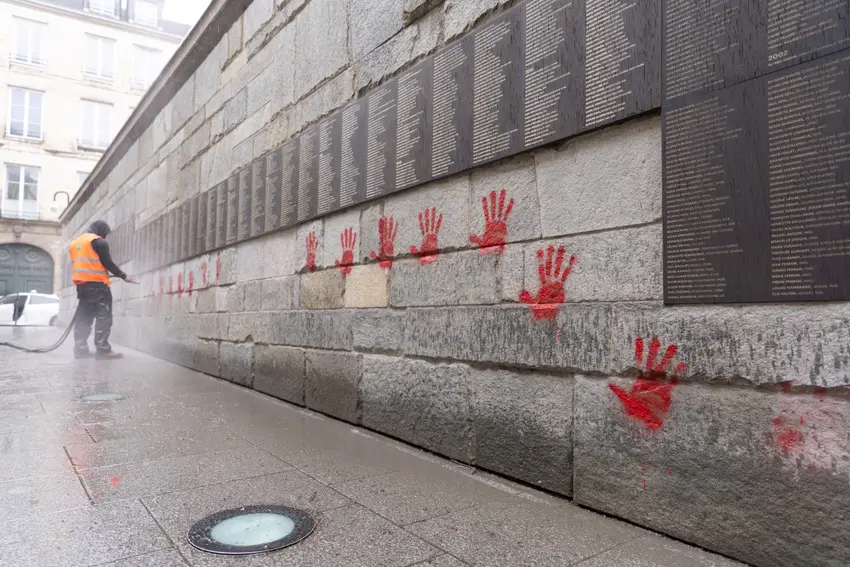
In June, criminal charges were levied against three Serbian nationals for vandalising Jewish sites, with investigators suspecting Russian involvement.
Before that, French President Emmanuel Macron himself said that he had "no doubt" Russia was targeting the Paris Olympics with disinformation.
Russia meddling in France is not new. During the 2017 presidential election, the hacking group 'Fancy Bear', which is associated with the Russian military, is thought to have leaked emails from the Macron campaign. Similarly, France accused Kremlin outlets of supporting the campaign of far-right candidate Marine Le Pen.
But watchdogs believe that the threat is intensifying.
READ MORE: OPINION: France's European elections are more than a poll on Putin
The face of interference
Russian interference in France has spanned everything from deepfake videos, like the false documentary criticising the Olympics called 'Olympics has fallen', including an AI-generated impersonation of Tom Cruise, to fictitious news stories, including forged content meant to look like mainstream French media stories in order to smear Macron.
There have also been organised efforts online to amplify and create hysteria around real news stories, such as the problems with bedbugs in Paris.
In autumn 2023, two fake news articles, made to look as if they had been published by the French regional news outlet La Montagne, circulated online.
The articles were shared widely across social media, alleging (incorrectly) that sanctions against Russia had exacerbated France's bedbug problem.
READ MORE: France blames Russian disinformation for bedbug panic
Russia's goal with such actions, both online and in person, is "to destabilise and sow chaos in democracy, particularly among Ukraine's allies," according to disinformation expert David Colon, professor at Sciences Po and author of the book ‘La guerre de l'information’ (The information war).
Colon explained that this can be done by increasing existing divisions, but also by making France appear weak on the international stage.
"They [targeted] the Olympics with disinformation to make people doubt France, to make them believe France is not capable of hosting such a large event," he said.
Nicolas Hénin, a former investigative journalist and current contributor to the (Mis)Translating Deceit project, told The Local that on a general level, "France is targeted as part of a global effort by Russia to break the cohesion of Ukraine's allies."
Sabotage
Hénin explained that the recent sabotage operations echo Cold War tactics, when Soviet operatives drew pro-Nazi signs on the walls in West Germany, causing discord and panic among Western countries.
"As for these recent incidents, I like to call them 'Flixbus operations', after the budget long-distance coach service that the perpetrators tried to escape France on.
"They are truly hybrid operations, in the sense that they start in the real world and then move into the online space.
"We've also seen this hybrid strategy with people bringing fake signs to real demonstrations, then taking photos of the signs and spreading them via proxies and online echo-chambers. Some of these recent operations have generated enough publicity that they did not even need to be shared online afterwards.
"The idea is the same as in the 1950s - to spark outrage, then from the outrage to cause or increase polarisation on topics related to international relations, nowadays being the wars in Gaza or Ukraine," Hénin said.
According to Colon, another small difference is the profile of those involved in the recent hybrid actions.
"While it is not new that there is action in both the real and online world, what is new is that Russia worked with Moldovans and Bulgarians to bring about these operations.
"This is related to the fact that there are fewer Russians in France. Following the start of the war in Ukraine, hundreds of Russian diplomats were expelled from Europe, and many of those engaged in spying under the guise of diplomacy," he explained.
Why is France a target?
France is a known ally of Ukraine, which has been known to anger Vladimir Putin.
During a 'Coalition of the Willing' hosted in Paris in early September 2025, Macron said that 26 countries pledged continued military support for Ukraine after any ceasefire deal with Russia.
But Hénin said, "France may also be a little more targeted than others because disinformation works.
"Cohesion here is not as strong as we wish (...) The rise of the far-right - and to some extent LFI (the left-wing party) - is a sign of a polarised society. When it comes to facing foreign interference, this is a particular vulnerability."
Colon also noted that "authorities were able to look at documents showing that the Kremlin sees France as a country that is particularly vulnerable to disinformation.
"This is partially because of the state of public opinion, as there are some French people who still have support for Putin, and there is a high level of mistrust or doubt in the media. They see France as a country where it is easier than elsewhere to spread disinformation."
Is France more targeted than elsewhere?
To the average person, it may appear that France has been targeted to a greater extent than other Western allies of Ukraine, but experts are not so convinced.
"I am not sure that France is more targeted than Germany, the UK, or even some central European countries. The notable difference is France's public transparency about Russian disinformation and the steps taken to prevent it.
"Until recently, France was very cautious about making public information about the intelligence world - hacking, spying, etc," Colon said.
"This has changed because Macron directly attributes Russia's actions and uses them within domestic politics to show how the country, and himself, have been targeted.
"Attribution is a sensitive and dangerous game. If you make it with good arguments, a foundation, and evidence, then it is clearly powerful. But there are risks," he added.
Hénin said there are two primary concerns, aside from the possibility that owning up to foreign interference could simply make the country look weak.
The first is that attribution "can trivialise and make foreign interference seem routine. Though I would say the answer to that is that we ought to disregard small-scale operations, or just sum them up in a quarterly report.
"The second is the possibility of being incorrect. It's worth clarifying that there is no evidence that any of the attributions so far have been false. It's fair for the government to continue doing this, but they need to be very careful.
"If you mistake one attribution, then your credibility is seriously damaged, and it will take a very long time to recover."
Who is winning the war of disinformation?
In addition to politicians calling out interference publicly, the French government has also taken administrative steps. For example, the creation of the government agency, VIGINUM, which is mandated to detect disinformation.
The agency was able to expose a dormant network of 193 websites nicknamed 'Portal Kombat' that could be activated during election periods to spread pro-Russian news in several languages (French, English, Spanish and German).
To Hénin, this has been a success, adding, "VIGINUM is a great initiative, and it really is working. Their limited mandate is a good thing - they have to focus only on foreign, online, impactful interference - if these conditions are not met, then they will not study the phenomenon."
Nevertheless, depending on who you ask, Russian interference has also been successful, though it can be difficult to quantify. "It's easy to divide the French public," Hénin said.
"The next steps must involve preventive work to offer media literacy training for the general public, all without giving too much space or importance to our adversaries."
As for Colon, he recalled the success of disinformation regarding the COVID-19 vaccination, as well as the growing rates of QAnon followers in France.
"If you look back to the Star of David operation, that sparked a huge debate amongst the French public. The Kremlin was able to accentuate existing divisions.
"The real impact of disinformation is to break down social cohesion in democracies, accentuate division, decrease confidence in institutions, diminish our capacity to react in a unified way and ultimately to break down our ability to distinguish between true and fake," the expert said.
Comments