
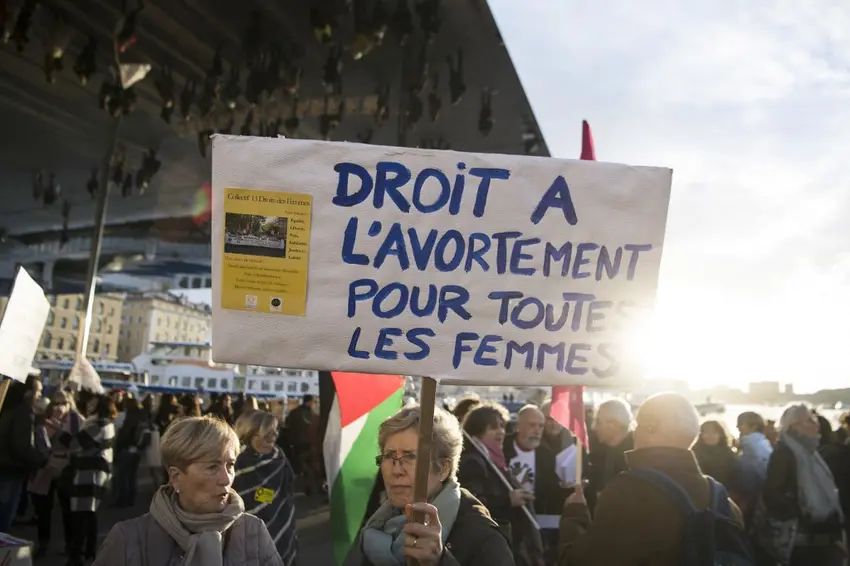
In March 2024, France became the first country in the world to clearly protect the right to terminate a pregnancy in its constitution. While the move was an important statement of intent, it did not change anything about daily access to the procedure in France.
That said, adding abortion to the constitution has made it much harder for any future government to roll back reproductive rights.
Historically, France was relatively late to legalise abortion - terminating pregnancy was legalised in 1975, driven by the politician and holocaust survivor Simone Veil - still a revered figured for many French feminists.
Before 1975 abortion had been illegal and vigorously prosecuted - the Vichy government that ruled France during World War II made it a capital offence and the last person to be executed under this law was Marie-Louise Giraud, who was guillotined in 1943.
The law
Abortion is available on demand in France, meaning there is no requirement to prove a risk to either the physical or mental health of mother or child in order to secure a termination.
Until February 2022, the limit for on-demand abortion was 12 weeks, but this was extended to 14 weeks in one of the last bills passed under president Emmanuel Macron's first term as president.
The 12-week limit made France one of the stricter countries in Europe, and around 3,000 women every year travelled abroad - often to the Netherlands, Spain or England, Scotland or Wales - to have an abortion because they had exceeded the legal time limit.
France is now in line with Spain and Austria where abortion is legal up to 14 weeks of pregnancy. In the UK, the limit is 24 weeks.
Abortion in France after 14 weeks is possible only in exceptional circumstances such as a risk of severe harm to the mother or a severe and incurable illness of the child.
The practicalities
In a medical context, abortion is known as Interruption volontaire de grossesse (voluntary interruption of pregnancy) and is frequently shortened to IVG.
Two appointments are required in order to secure an abortion and these can be with a doctor (either your registered GP/family doctor or another), a midwife or at a family-planning clinic.
At the first appointment you will be given information on your options and the methods of abortion available and offered counselling if you want it.
At the second appointment you confirm your request for an abortion in writing, and receive an attestation de consultation médicale.
You can have either a medical abortion - taking medication to bring on a miscarriage - or surgical termination, and the method used depends on your choice and the stage of your pregnancy.
Under 18s have the right to an abortion and do not require parental consent, but in their case counselling is mandatory.
Abortions are refunded 100 percent through the French state health service so if you have a carte vitale you will have nothing to pay.
READ ALSO How to get a French carte vitale and why you need one
If you are not covered by the French state system you will have to pay. For a surgical abortion, costs range between €579.06 - €830.06, depending on the health establishment (hospital or clinic), the type of anaesthetic (local or general) and the length of hospitalisation.
For a medically induced abortion in a health establishment, the rate is €353.64.
You can find full details on the process and payment here.
Doctors are permitted to refuse to perform abortion on moral grounds, but in France you are free to see any doctor you choose - you are not limited to only your registered doctor.
As for other forms of reproductive healthcare, the French health system reimburses the costs of egg freezing - which range from €2,000 to €3,000 - for women aged 29 to 37 (more info here), but it is up to the individual to pay storage fees (approximately €45 per month, as of 2024).
IVG (referred to as Procréation médicalement assistée, or PMA) has been legal for all, including single women and gay couples, since 2021.
The politics
While the initial move to extend the abortion time limit was met with some opposition, it easily attained the required majority in parliament.
Valérie Pécresse, the rightwing Les Républicains party's 2022 presidential candidate, at the time spoke out against the extension to 14 weeks, calling it "a headlong rush that distracts from the real problem: access to abortion centres, the lack of gynaecologists and midwives" while MPs from the far-right Rassemblement National attempted to table a bill to block the changes.
However the move to enshrine the right to abortion in the French constitution - called by Emmanuel Macron in response to the overturning of the Roe v Wade legal precedent in the US - received huge support from across the political spectrum.
It passed in the Assemblée nationale by 337-32 votes, while the male-dominated and traditionally socially conservative Senate passed it by 267 votes to 50.
As of 2022, 85 percent of French people supported enshrining the right to abortion in the constitution.
As for far-right leader and former presidential candidate Marine Le Pen, she has long tried to obfuscate her position on abortion in hopes of modernising and softening her party's image, while holding on to its Catholic conservative fundamentalist base. But she has, in the past, criticised what she termed “comfort abortions”.
In her 2006 autobiography À contre flots, she laid down her thinking on abortion, claiming some women use it as ‘a form of contraception, and calling for, “incentive measures, coupled with a real policy of information and prevention with adolescent girls” in order to better “fight against abortion”.
Comments