
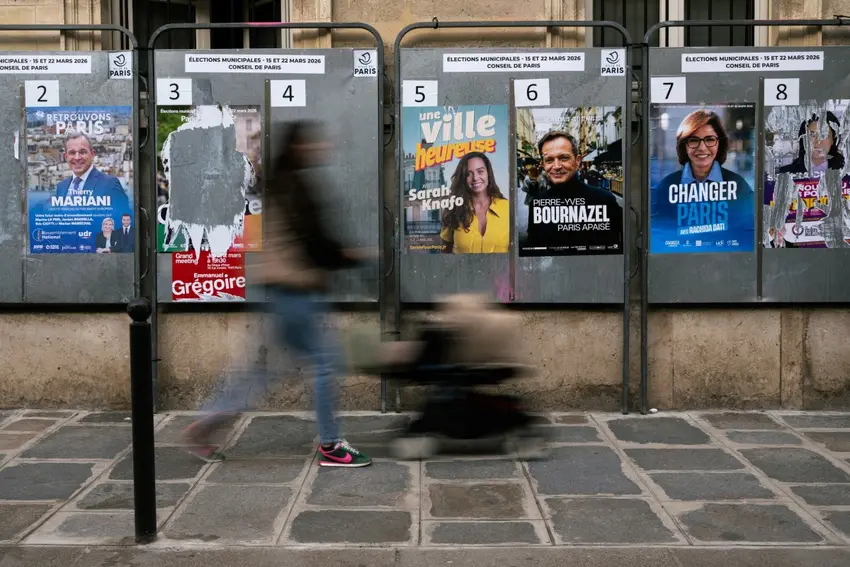
Soon France's 34,000 villages, towns and cities will head to the polls to elect their mayor, and local council.
Here are some words and phrases that you are likely to hear;
Un bureau de vote - polling station. A bureau de vote is indicated on the voter card. Polling stations are usually located in schools or public buildings and are open from morning (usually 8am) to evening (6pm-8pm depending on the area).
READ MORE: Everything you need to know about France's upcoming local elections
Carte électorale - voter card. The voter cards are sent by mail before the election. They are not required to vote but will be stamped if brought to the polling station. A valid ID is the only document required to be able to vote, provided you are on the electoral roll.
Voter - to vote. To vote in the 2026 local elections in France, you must be at least 18 years old before the first round, and you need to be registered on the electoral rolls of a French municipality. You must be a French citizen or a citizen of another European Union member state residing in France.
A voté - has voted. This is always said by an official when the voter has dropped their envelope in the ballot box.
Vote par procuration - voting by proxy. France does not allow postal votes, but if you are not able to attend the polling station on the day, you can arrange for someone else to cast your vote.
Premier tour - first round. The first round of local elections will take place on Sunday March 15th.
Second tour - second round. The second round of local elections will take place on Sunday March 22nd.
READ ALSO: How to arrange a proxy vote in France
Un isoloir - polling booth. These allow each voter to choose the candidate they will vote for in secret. Isoloirs are mandatory to guarantee the right to free election.
Une urne - ballot box. Where each voter drops their ballot paper. You might also hear this as a rally cry 'aux urnes' - let's go and vote.
La clôture du scrutin - the closing of polls. The time of this depends on the Préfectoral decree. It can close at 6pm, 7pm or 8pm depending on the town and big cities tend to leave their polls open until later.
The president of the polling station officially announces the hour of the closing of polls and from that time no more votes can be cast. However, if a voter has entered the bureau de vote before the closing time, they can drop their ballot in the urne.
Le dépouillement des votes - counting of ballots. This starts as soon as the polls close. The tellers from both sides count the vote under the eye of the members of the bureau.
Les estimations de résultats - provisional results. Once the ballot is closed, a detailed provisional result is published, which usually gives an accurate guess of who has won.
When it comes to national and presidential elections, these are produced by taking sample votes from selected polling stations, which give a remarkably accurate early indicator of the result. This means that French elections tend not to be all-night rolling news affairs like UK elections or days-long rolling news affairs like US presidential elections. Less exciting perhaps, but journalists appreciate getting their beauty sleep.
READ ALSO: How do the French produce such accurate early election results?✎
Candidat/ candidate - candidate (male or female). To run in local elections in France, a candidate must be at least 18 years old, have full civil and political rights, and be registered to vote in the municipality or have a local connection such as paying local taxes. Candidates can be French or other EU citizens, but only French citizens can become mayor or deputy mayor. They must submit an official candidacy declaration to the préfecture and can run in only one municipality.
Candidates run on a list with other candidates rather than individually, and these lists must follow gender parity rules by alternating male and female candidates. After the election, the municipal council members who are elected then vote among themselves to choose the mayor.
Tête de liste - head of the list. This is the lead candidate of an electoral list. The tête de liste is the person who leads the list during the campaign and is usually the main spokesperson and public face of the team. Those at the head of the list for the major parties are therefore fairly certain to be elected, unless the party suffers a complete electoral wipeout.
Favori/favorite - the favourite or candidate considered most likely to win. For example, in Paris, it's a very tight race between left-wing Emmanuel Grégoire and right-wing Rachida Dati. The polls say the favourite remains Grégoire for the moment.
Coude à coude - neck and neck. Literally translated as 'elbow to elbow' this is a figurative way of saying that two political contestants are very close in the polls.
Serré - very close. Another way of describing a race as very close is serré (tight).
Une alliance - an alliance. An alliance is exactly what it sounds like, but the complicated nature of France's two-round voting makes this concept an essential part of elections, from local to parliamentary, right up to presidential.
Cordon sanitaire - a political strategy in which mainstream political parties refuse to cooperate with or form alliances with a particular party, usually because they consider its ideas extreme or unacceptable. The goal is to isolate that party from political power, even if it wins votes in elections.
In France, the term is often used when parties agree not to form coalitions or support candidates from the far-right, such as the Rassemblement National (RN). By maintaining this cordon sanitaire, other parties try to prevent that party from gaining leadership positions or governing power.
Comments