
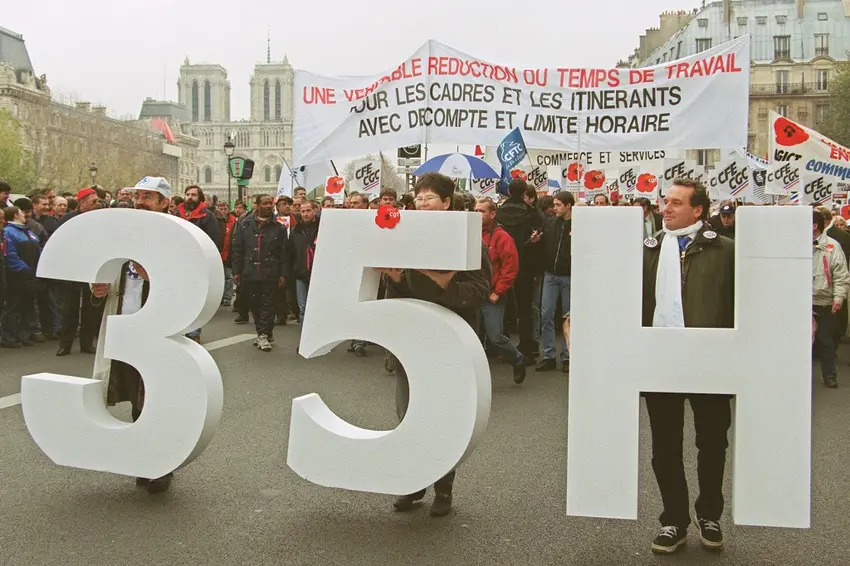
It's a fairly regular occurrence for politicians and business leaders to take aim at the 35-hour work week rule, claiming it stands in the way of allowing France's economy to thrive the way it should.
Yet it has existed for over 20 years and no one has yet managed to roll it back.
Meanwhile proponents hail it as a social totem, a milestone in the fight for worker's rights.
What is the 35-hour rule?
The 35-hour rule was adopted in 2000 under the Socialist Party Prime Minister Lionel Jospin, and became mandatory for all French businesses in 2002.
Before that, France's upper work-limit was 39 hours a week, a rule established by then-President François Mitterrand, also from the Socialist Party.
While the 35-hour law did not make it illegal to work more than those hours, it did mean all additional hours had to be considered overtime.
The goal was to reduce unemployment by encouraging businesses to hire more people instead of making employees working more.
Do the French actually work only 35 hours a week?
No, according to the French Institut Montaigne, the average French work week in 2022 was 39.8 hours, while French statistics agency INSEE found that the average work week for full-time employees was 40.1 hours in France.
Based on EU estimates from 2023, the numbers differ slightly with the French working 36 hours per week, just short of the European average (36.1).
In comparison, Greece had the longest working week with 39.8 hours, followed by Romania with 39.5, Poland with 39.3 and Bulgaria with 39.
On the other side of the spectrum, the Netherlands had the shortest working week of 32.2 hours, followed by Austria with 33.6 and Germany with 34.
Nevertheless, only 28.4 percent of French workers find themselves actually following the 35-hour week, according to BFMTV, while 35 percent say they often work during the weekends, on bank holidays, or at night after 8pm.
But working more hours does not necessarily translate into more productivity. A 2018 study by the UK Trade Union Congress (TUC) saw findings proving the contrary. The TUC General Secretary told Euronews that a long-hours culture was "nothing to be proud of."
But - and this is key - people who work more than 35 hours in a week in France may be entitled to extra pay or extra days off, the precious RTT days (réductions de temps du travail).
This doesn't apply to everyone - generally people in management or executive positions forego RTT days and certain professions have also opted out but for many people working a 39 or 40 hour week means getting up to an extra fortnight off a year in reclaimed RTT days.
French public sector workers who work a regular 35 hour week can get 34 RTT days a year - in addition to their statutory 25 holiday days - and private sector workers can get 27 - if they aren't exempt from the rule.
The gap widens as workers increase their hours. Public sector employees working more than 39 hours get 42 RTT days while the private sector employees can get 31.
There is also a difference between the public and private sector with respect to how many RTT days workers generally take, with Labour Ministry study from 2017 showing that employees in the public sector taking 46 on average and private sector employees taking 29.
All in all, the RTT system is costly for the state, a 2020 study by the French research institute Montaigne suggested that France could save around €7 billion a year by increasing the regular work-week to 38 or 39 hours.
So why do some people want to get rid of it?
Well, to save money, for one.
French President Emmanuel Macron’s 2017 presidential campaign pledge was not to abolish the 35-hour week completely, but to “return flexibility” to companies.
Meanwhile there have been various attempts to change the rule for healthcare workers, in order to make the healthcare sector more flexible.
In October 2024, with France's budget deficit spiralling and an austerity budget looming, politicians are once again suggesting getting rid of the 35-hour week to boost the economy.
Comments (3)