

If you're watching any Paris Olympics coverage then the chances are you will have heard La Marseillaise rather a lot. And not just at medal ceremonies - French fans are fond of belting out their national anthem at any exciting moments during sports.
You've probably already observed that it has a rather good tune - but its lyrics are a little more controversial.
What does it sound like?
Let's get it out of the way early. Here's a YouTube clip of the song.
It's a rousing tune that really lends itself to sporting events in the way that the more solemn/boring anthems (looking at you God Save the King) do not.
The French anthem is of course used at formal events - it's sung before matches in international sporting fixtures, it's played at state events such as the July 14th ceremonies and a slowed-down orchestral version is often played at state funerals or memorial events.
But French sports fans will frequently start an impromptu version of the anthem whenever they feel that their athletes need a boast - as such you will hear it sung a lot during the Olympics and also if you happen to be watching a France match in a bar.
What's the song about?
It's a call to arms - a rousing war song to rally French troops battling foreign armies. It's meant to incite an uprising against tyranny and invasion.
The lyrics are quite strong, and make for an impressive and combative start to an international sports fixture.
So what about these lyrics then?
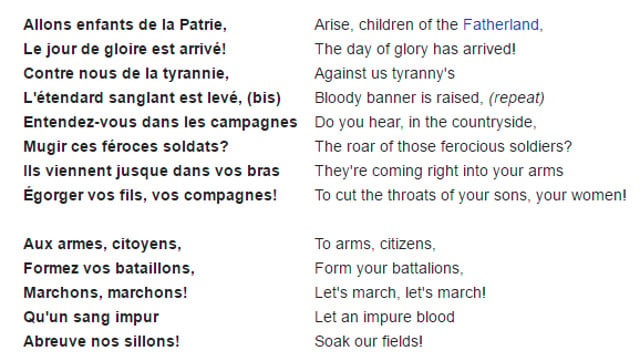
The anthem contains lines about "ferocious soldiers" who are "coming to cut the throats of your sons, your women".
The chorus ends with a call for "impure blood to soak our fields".
Read the first verse and chorus here.
What's the history of the song?
It came about, as the story goes, in 1792 when the mayor of Strasbourg, Baron Philippe-Frédéric de Dietrich, called for a song to rally France's soldiers. That very same night, his guest Rouget de Lisle wrote and delivered it.
Three years later, it was officially passed as the national anthem of France. It has been banned a few times since, notably by Louis XVIII and Charles X, but was reinstated in 1879 and has remained as the national anthem since then.
If it was invented in Strasbourg, shouldn't it be called the 'Strasbourgaise'?
Great question. The reason it's called the Marseillaise is because volunteer troops (fédérés) liked to sing it when marching from Marseille to Paris during the French revolution.
That's a march of 750km, by the way, so you can see why they might have needed a pick-me-up.
Have there been other controversies around it?
Of course - did you read those lyrics? In recent years some have said the song is no longer appropriate for modern multi-ethnic and peaceful France.
There was a big push in 2014 to change the song, or at least the lyrics.
"When I hear the words 'let an impure blood soak our fields', I am amazed that we continue to sing it," French actor Lambert Wilson said at the time.
Various famous French figures from the past have also had issues with the song. Author Victor Hugo, French Socialist leader Jean Jaurès and the singer Serge Gainsbourg (who released a reggae version in 1979 which infuriated many traditionalists) all thought the Marseillaise should be given a makeover.
Does everyone think it's inappropriate?
Nope. Many people really like it - and will happily argue that there's nothing wrong with the words.
"There’s no way the words are racist," French political expert Jean-Yves Camus told The Local in the past.
"They just have to be put in the context of 1792 when France was being besieged by foreign armies. The lyrics are strong, but not racist."
Lyrics aside, it's definitely one of the most rousing national anthems out there (although some think Italy's is better) and hearing 80,000 sports fans belting it out will raise the hairs on the back of your neck.
And lastly... How can I sing along if I don't speak French?
You could try this phonetic guide.
Here's how to sing French national anthem, the Marseillase, for tonight's Euro final. pic.twitter.com/IbRMtxhmNc
— Oliver Gee (@olivergee23) July 10, 2016
Comments (1)