
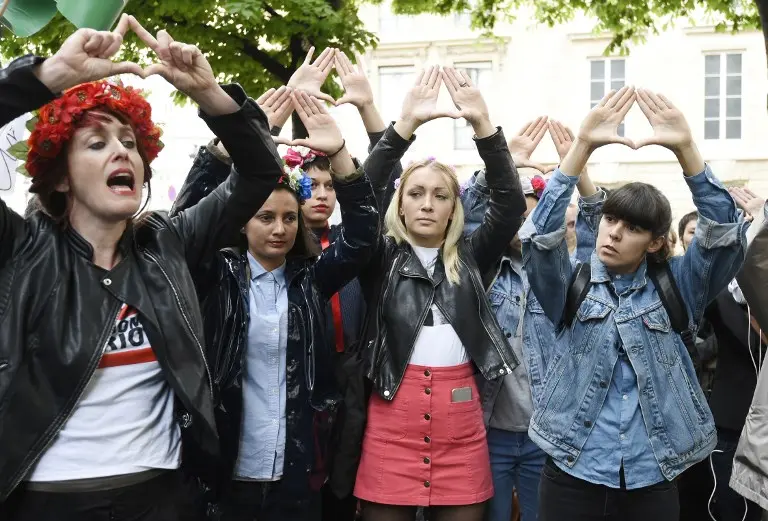
The survey, carried out by polling institute Odoxa for Le Figaro and Franceinfo, revealed that a massive 53 percent of French women have experienced sexual harassment and/or assault at least once in their lives.
This includes sexual assault like touching, putting hands on buttocks and forced kissing, as well as sexual harassment like inappropriate and degrading remarks, sexually related insults and sexual advances.
For 91 percent of the women surveyed, the question of harassment and sexual aggression is an "important" issue today.
The study, which surveyed 995 women and men, comes at a time when women across the world are starting to speak out about their own experiences of sexual harassment in the wake of the flurry of accusations against Hollywood mogul Harvey Weinstein.
And more and more women in France are coming forward and publicly pointing the finger at their attackers.
READ ALSO:
- Women in Paris tell their stories of being groped, pestered and sexually harassed
- 'Squeal on the pigs': French women bombard Twitter with tales of sexual harassment
- Men in France to face on the spot fines for sexually harassing women
Photo: Jean Francois Gornet/Flickr
In France on Friday, 28-year-old French writer Ariane Fornia, claimed in French newspaper l'Express that she was sexually assaulted by one of ex-French president François Mitterrand's minister's Pierre Joxe.
Fornia, daughter of an ex-minister to ex-French president Nicolas Sarkozy said that when she was 20, Joxe groped her at a classical music concert.
He has vehemently denied her accusation.
[INFO L'EXPRESS] Ariane Fornia, fille d'Eric Besson, accuse l'ex-ministre Pierre Joxe d'agression sexuelle https://t.co/ax95uLBSKt pic.twitter.com/QV3QMfGg0i
— L'Express (@LEXPRESS) October 20, 2017
The revelations come just one day after French television channel M6 pulled "France's Got Talent" on which Canadian producer Gilbert Rozon is a judge after he was accused of sexual assault and harassment.
Earlier this week a women took to Twitter to accuse former French presidential candidate Jean Lassalle of groping her. An accusation he was forced to publicly deny.
In the Odoxa survey published on Friday it was revealed that 36 percent of women have been "victims of sexual assault", 38 percent of "sexual harassment outside of work" and 17 percent of harassment "at work".
While six percent of men said that they had also been victims of sexual assault, five percent of sexual harassment outside work and seven percent at work.
Asked about the hashtag "#balancetonporc" or 'Expose the pig" started by a French female journalist to encourage women to share their stories of sexual harassment, 61 percent of respondents (52 percent of men) said they thought it was "a good thing" because "it liberates the words of women and shows that the problem is much greater than recent media stories show".
However 38 percent of women (47 percent of men) thought that it was a "bad thing" because the messages "aren't real witness statements but instead unverified denunciations that could allow for misconduct".
In France there are attempts to address the issue in the form of a new law set to be introduced, which will see on-the-spot fines imposed for sexual harassment of women on the streets.
The legislation is being piloted by 34-year-old Marlene Schiappa, a feminist and early supporter of French President Emmanuel Macron who wants to tackle sexist male attitudes in public spaces.
Comments